

A toll road is a road where access is subject to a fee, called a toll. For this to work, two things need to be in place:
i) the road needs to add value compared with other means of transport, either in being the exclusive route from A to B, or being of superior quality, such as smoother and less rutted; and
ii) there must be some way of restricting access to the road, so that only those who pay the toll can use it; the ability to exclude is key to charging for any commercial service, otherwise people will use the asset without payment (called free riding) and the owner will have no incentive to provide or maintain it.
The toll road must therefore have some form of gate that limits entry only to those who pay the toll. One version of this used a form of rotating spike that resembled the devices used in war to block cavalry, known as turnpikes.
Today, many countries routinely use tolls to pay for the capital and running costs of roads. This can be either in the public or private sector, in both advanced and developing economies. Toll roads have the twin advantage of generating the means of payment for their upkeep and being paid for by the users of the roads, as opposed to coming out of general taxation.
We’ll look at the economics of toll roads separately. In this post, we’ll examine the history of the modern toll road.
Charging road users has a long history
For most of human history, the only way of getting around for ordinary people was to walk. Humans are able to walk across almost any terrain, though sometimes with difficulty. But it’s slow, sometimes hazardous and you can’t carry much.
A lucky few people had donkeys, mules or horses. These could go further, faster and could carry more. They didn’t need much of a path, though some terrain would be easier for people than for horses.
When wheeled carts came into use it started to really matter what sort of surface you were moving along. A better quality path – let’s now call it a road – made for easier, quicker and more stable transport. Even a couple of ruts might be better than nothing, though a bouncy, rickety path was not suitable for fragile goods – pioneering English potter Josiah Wedgwood financed the Trent and Mersey Canal in 1766, since English roads were too rutted and uneven for safe carriage of his fragile pottery (the canal greatly reduced transport costs too).
The original porcelain imported from China (it took the Europeans centuries to figure out how to make it) mostly came to the Middle East and Europe by sea, as the overland method was too uneven. There is a reason we refer to the Silk Road rather than the Porcelain Road.
Turning a path or track worn by repeated use into something better requires resources, both for the initial investment and then for maintenance. If the road was on private land it might be worth the landowner paying for it, but roads are generally longer than the extent of any one person’s ownership, unless that be the emperor, king or other leader. Even so, the costs had to be paid for. An obvious solution is for the people who use the road to pay a fee, or a toll, for the right to do so.
There is evidence of what we would now call toll roads in the Achaemenid (First Persian) Empire in the fourth and fifth centuries BCE and in southern Arabia in the first century CE. Travellers were being charged at road checkpoints in ancient China at least as far back as the Warring States period (fifth century BCE). Roman roads, which were famously of high quality, mostly did not charge tolls, being funded publicly, though the construction was often done by an early form of private company called societas.
In most of these cases the levy was mainly a charge on the transport of goods, rather than a service charge for a proper road. Before the advent of modern taxation, government income came mainly from charging for the passage of goods, what we would now call a tariff.
In medieval Europe, during the Holy Roman Empire, merchants were required to use and pay a toll for the major long distance roads. This was mainly a feudal fee for the Emperor but travellers also expected to receive protection while using the roads.
The idea of charging a toll specifically to pay for the road itself seems to be more recent, starting with the turnpike roads that began in England and Wales from the 17th century. In the 20th century, road charges were further extended to reduce congestion, where the collection of revenue was secondary to the need to limit traffic.
English turnpikes (17th to 19th century)
In England in 1555, after centuries of mostly poorly maintained roads and limited mobility, Parliament passed the Highways Act. This made the building and upkeep of roads in England the responsibility of local parishes (the smallest unit of local government, also responsible for poor relief, church construction and constables, an early form of police). Being unable to borrow, parishes had to pay for everything by levying local property taxes. They were also allowed to call on local people to provide up to four days of unpaid labour (later increased to six days), with wealthier landowners also required to provide a cart and horses, an arrangement that continued until it was repealed in 1767.
Lacking financial resources and unable to charge travellers passing through their parish for the use of the road, parishes had little incentive to invest in good quality roads. And if an adjoining parish didn’t invest, it made even less sense for the next parish to bother to improve the roads.
The generally poor state of roads became intolerable with the growth of trade in the 17th century. Tolls had been introduced by King Edward III in 1346 to pay for specific road improvements in London, but were not widely used until an Act of Parliament in 1663 granted the right to local magistrates to charge tolls for parts of the Great North Road, which ran from London to York, in Hertfordshire and Cambridgeshire. Similar tolls were allowed in other counties soon after.
This was the start of a wave of Acts of Parliament to allow charging of tolls for improvement and maintenance of roads. They were known as Turnpike Trusts. The turnpike was a device to limit entry to the road and owed its name to its resemblance to the military bars attached to sharp sticks that had been used to defend against cavalry charges. Unlike the earlier tolls, which were quite local and administered by magistrates, Turnpike Trusts could appoint any respectable person as a trustee and could cover a longer section of road. They could also borrow. Figure 1 shows a painting of the entrance to the Tottenham Court Road turnpike in London in 1813.
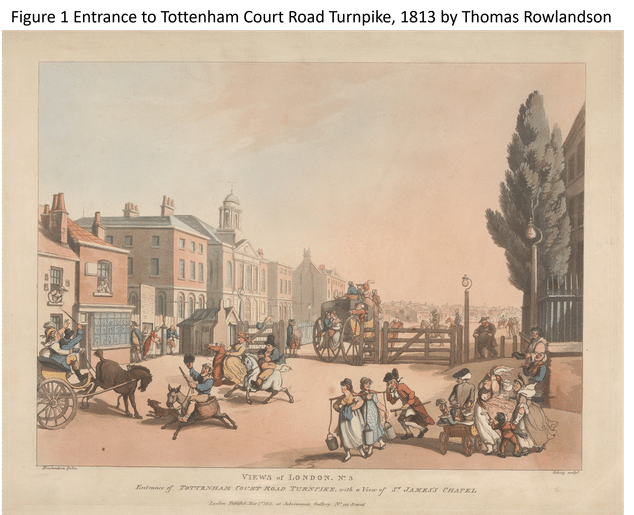
Note that the entrance shown in figure 1 is actually just a gate. The original turnpike (or turnstile) had long since fallen out of use.
The Turnpike Trust solved three problems:
i) the lack of funds under the parish system;
ii) the inability to charge people passing through, which undermined incentives to improve widely used roads; and
iii) the coordination problem of different parishes needing to work together to improve a longer section of road.
Trusts were self-funding and not-for-profit, typically granted for 21 years. They were in effect public bodies, managed locally, to mobilise national resources, since they could borrow against future toll revenue. But in substance there were the same as modern toll roads. Although each one needed its own act of parliament, this was usually easily and quickly achieved.
The turnpikes greatly increased the quality and capacity of roads in England and Wales. It wasn’t always popular with local people who had previously had free access to the roads, and there were protests in some areas. Riots in rural west Wales in 1839 were focused on the toll gates as symbols of the oppressive cost of living.
Turnpikes went into decline with the coming of the railways and roads passed into local government management during the 19th century, and tolls were replaced by local taxation. Toll roads disappeared in the UK until the end of the twentieth century.
Turnpikes in the USA
The legal form and the name of Turnpikes was adopted in the USA, starting with the Philadelphia and Lancaster Turnpike in Pennsylvania in 1792. But typically the state granted a charter to a private company operating for profit, unlike the not-for-profit British model. Figure 2 shows a share certificate for the Philadelphia and Lancaster Company.
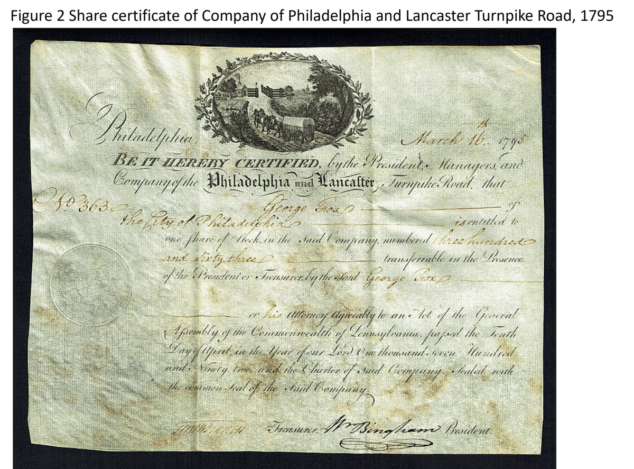
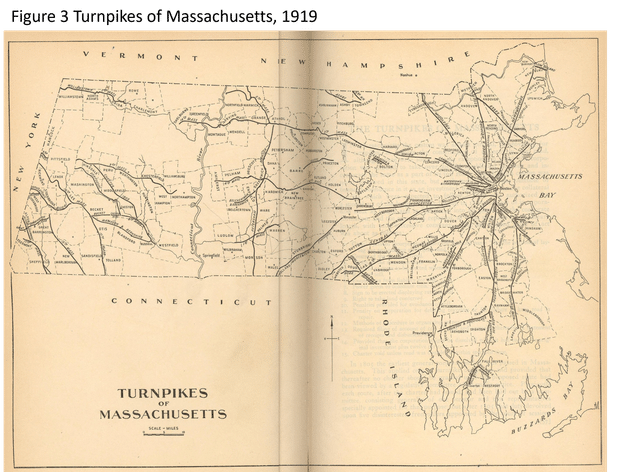
Otherwise, US turnpikes were much the same as those in England and Wales. By the mid-19th century there were around 1,500 turnpike roads across 11 states, the great majority organised as private shareholder-owned companies. Figure 3 shows the extensive network of turnpike roads in the Commonwealth of Massachusetts in 1919.

The name turnpike dropped out of usage and even memory in the UK. But it lived on in the USA, coming to refer to any toll road. By 1920, the great majority of private toll roads had passed into public ownership, either when their contract expired or when they became financially unviable. Public sentiment during the Progressive Era was against private ownership of roads. The growing ownership of automobiles made stopping to pay tolls increasingly irksome (the technology for paying while still in motion only emerged much later in the century).
Today there are several major toll roads in the US with the name turnpike, including the Massachusetts Turnpike (“MassPike”), which is a 222km (138 mile) toll road, owned and operated by the State of Massachusetts Department of Transportation (figure 4).
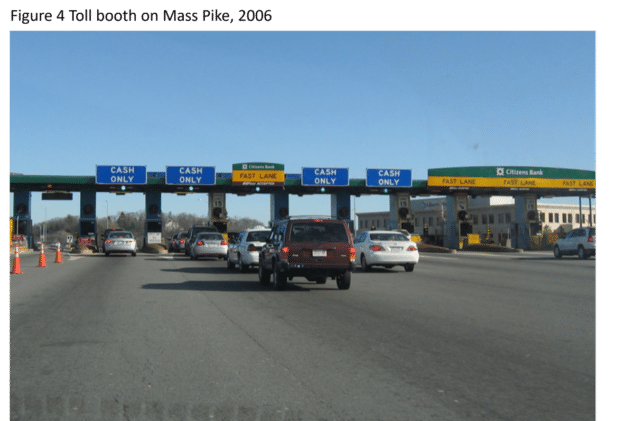
In 1956 President Eisenhower inaugurated the construction of the Interstate Highway System, paid for with federal government funding (apparently, being a fiscal conservative, Eisenhower would have preferred toll roads, but was persuaded out of this). After the completion of that system in 1992, new roads have sometimes been built as toll roads. Turnpikes like the MassPike live on, mainly in the eastern part of the USA, partly as a source of state income.
There are a few modern privately owned toll roads in the US, which are called private highways, since they are typically expressways that offer faster, less congested routes compared with the public freeways.
Other countries
Tolls re-emerged in the 20th century in various countries as a way to pay for new, higher quality motorways or expressways to serve the rapidly growing automobile market. The first such was the autostrada from Lake Como to Milan, in Italy, opened in 1924 and paid for by tolls. Greece, France, Spain and Portugal followed in the next few decades.
An important point here is that it is politically easier to charge a toll for a brand new road that offers a superior service (essentially speed and comfort), particularly when there is an inferior alternative route. Although some people object to the idea of a two-tier service, it is easier to justify building a new road if the users will pay for it, rather than taxpayers in general, especially when many of them may not have owned a car at that time.
Modern toll roads in developing countries: PPPs
Toll roads have become a normal way of financing new road infrastructure in developing countries, including China, India, Mexico (*), Indonesia, Thailand, Malaysia, South Africa and Zambia, among others. The World Bank’s private participation in infrastructure (PPI) database lists 37 countries with private investment of some sort, with Latin America the region of highest activity.
Many toll road projects (though not China or India) were sponsored by the World Bank and its IFC affiliate, which is an enthusiastic promoter of public-private partnerships (PPPs).
The basic idea of a PPP is that there is a public sector client (usually national or local government) which signs a contract for building, maintaining and operating a new infrastructure asset (in this case a road). The funding comes from a toll. The contract usually places the road in public ownership after a period of say 25 years, long enough for the private investors to recover their capital and make an acceptable return. At the point, the public sector owner can either retain ownership or auction it off to new owners.
PPPs save the public sector from having to provide financing, and allocate to the private sector the management of risks which they are in principle better able to manage, especially construction risk. As of 2024, about 19% of the IFC’s total $2.9bn investment in transport was in the road sector. But the total investment including private investors would be a much higher number.
The UK exception
Oddly, the UK, which invented toll roads in their modern form, has only one today. Unlike most other European countries (though Germany is also an exception), the UK chose to pay for its new motorway network from public funds, with the first new road opening in 1958. It was argued that car users were already taxed quite heavily via petrol taxes and the road tax on cars. The mood of post-war Britain was in favour of state provision of essential services. The motorway network is also relatively small in the UK, compared with France, and cheaper to build than in Italy, where steep mountains had to be crossed or tunnelled through.
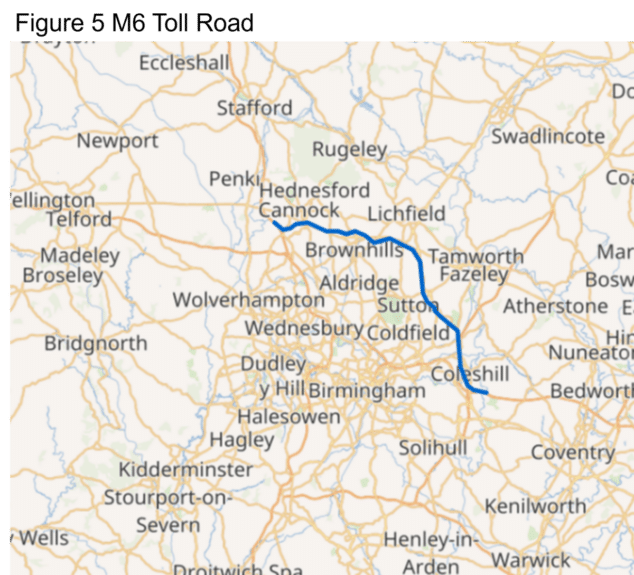
Under the pro-privatisation government of Margaret Thatcher from 1979, the idea of toll roads was revisited. But it was obviously going to be difficult to start charging existing motorways which had previously been free. One new motorway was eventually constructed as a private project funded by tolls, the M6 toll, which connects the motorways to the south of Birmingham (the UK’s second largest city) to the route to the north, allowing an alternative route for bypassing the city. Opened in 2003 with a 53 year concession, this route never achieved the forecast traffic flows, though it did reduce congestion on the existing, free motorway bypass on the west side of the city (see figure 5).
It’s hard to pin down why, but British drivers seem to resent the idea of paying a road toll, other than for a very specific asset such as a bridge or tunnel. Economists are reluctant to use culture as an explanation for behaviour but I’m at a loss as to any other reason why toll roads have failed to catch on in the land of their invention, even when the public sector budget for road building is highly constrained (many road projects where quietly cut in the October 2026 budget).
Conclusion
Toll roads work in theory and in practice – except in the UK. They satisfy the economist’s ideas of efficiency (users face the economic cost of their journey, so they should take a rational decision as to whether it’s worthwhile) and fairness (users of the road pay for it). Having recently travelled from Normandy to Paris on a series of well maintained, uncongested and high quality toll motorways, I can only regret that we seem to have rejected them in Britain. But many other countries have found them a highly effective way of adding to the road network without stretching the government’s budget.
*
(*) Mexico’s experience of toll roads was not a happy one, as we will examine another time.
Further reading
Daniel B. Klein and John Majewski, Turnpikes and Toll Roads in Nineteenth-Century America
Leave a Reply