

Introduction: corporate finance versus project finance
The usual way in which a company raises finance to run and grow its business is called corporate finance, where equity investors and debt lenders provide capital to the company as a whole. Most companies have more than one investment, sometimes many, but the investors are taking the risks and returns on the whole portfolio of those projects, treating the company as a whole entity.
But it’s possible instead to set up a special type of company, known as a special purpose vehicle, to raise debt and equity to invest in a single, standalone project. This is called project finance, and it’s commonly used in infrastructure investments. It is more complex and costly but it provides for greater clarity on who bears risks and responsibilities for building and managing the project. This in turn can induce banks to lend more than they would to a normal company, reducing the overall cost of capital (debt is cheaper than equity owing to tax treatment). It also means that external shareholders who invest in the project limit their exposure to the project. If something goes wrong, the banks lending to the project have no claim on or recourse to those external shareholders.
We first show the basics of standard corporate finance, then show how project finance is different, before exploring the costs of benefits of the project finance approach.
Corporate finance
Figure 1 shows the balance sheet of a company that might have been set up to make business investments with the intention of making a profit. If you’re not familiar with balance sheets, a helpful way to think about them is that they answer two questions:
i) how did the company finance itself, and
ii) what did it do with those financial resources? (*)
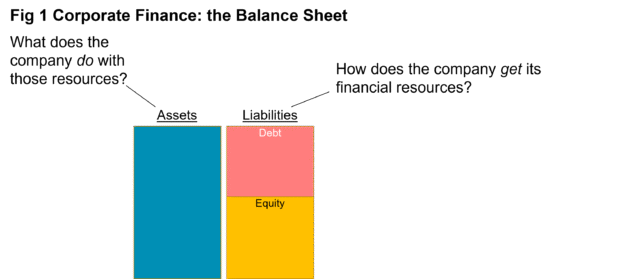
Anyone investing equity, or making a loan to the company, is exposed to the risks and returns of any assets the company owns. For most companies, even quite simple ones, that might involve a range of activities, including buildings, vehicles, a factory or offices, intellectual property and so on. The combined outcome of the company’s success in managing all of those assets, including its ability to find and develop customers and employees, manage risk and so on, leads to a set of cashflows (hopefully) out of which the debt is serviced. If there is anything left over after paying the debt-holders, the residual income is available to be distributed as dividends to the shareholders, or reinvested in the business, depending on what the directors believe is in the shareholders’ best interests.
Figure 2 shows the relationship of external providers of debt and equity to the company.
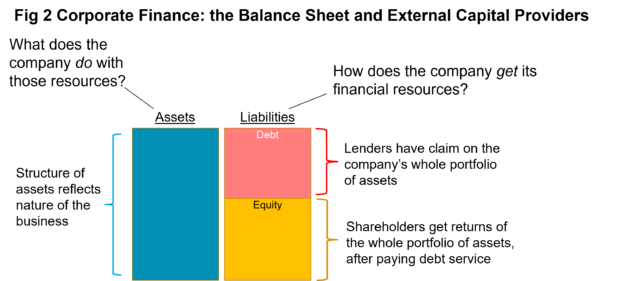
It is the company as a whole that is raising finance. Perhaps the company has one very valuable asset, but also some failing ones. The lenders and shareholders must take the combination as a whole. If the overall result is insufficient cashflow to pay the debts, the lenders cannot take the good asset as payment – unless they have specifically got a contract that makes that asset secured collateral for the loan.
Project finance
For large and complex projects, it may make sense to treat the project itself as the object of interest. So the project sponsors, meaning the founding shareholders, set up a special purpose vehicle (SPV), meaning a company with one asset only – the project itself. That company then is the hub for any contracts or financing concerning the project. The key cashflows are shown in Table 1
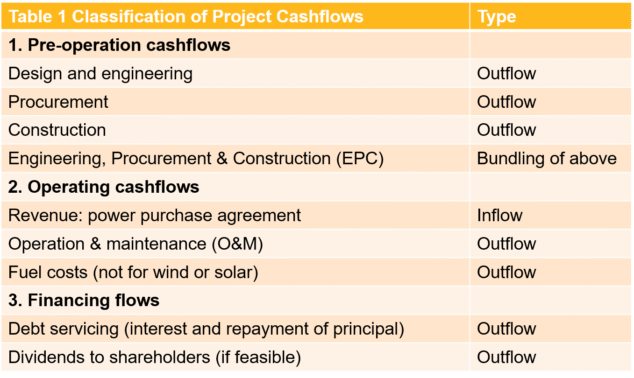
Additionally the SPV will raise equity finance from shareholders (usually more than one) and debt finance from one or more banks. All financial and contractual arrangements, including tax and insurance, go through the SPV.
Figure 3 shows these cashflows for the example of a wind farm project, with the the project company (the special purpose vehicle) as the hub.
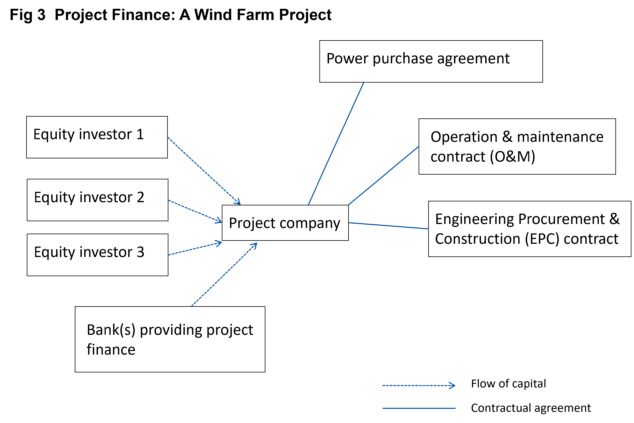
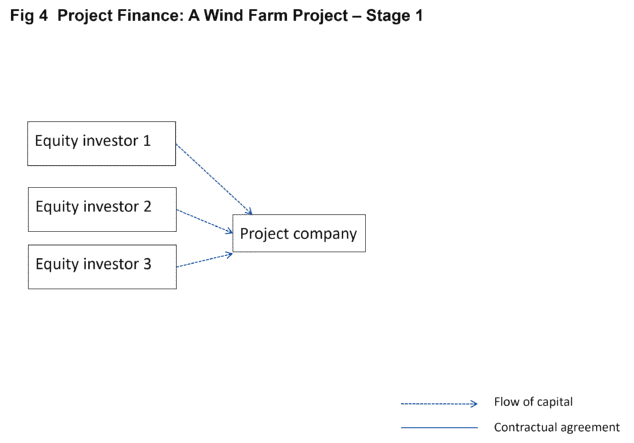
In case this looks a bit too much to take in, let’s break it down by the stages of the project. The first stage is where one or more equity investors come together to investigate setting up a project. They first set up the special purpose vehicle project company, which will then go on to handle all the subsequent contracts (figure 4).
At this stage we just have a company. But if the investors decide to go ahead, they will provisionally sign agreements for the key parts of the project: first, the pre-operation parts (engineering, design, procurement and construction); and then the key operating contracts: revenue and operating costs (figure 5).
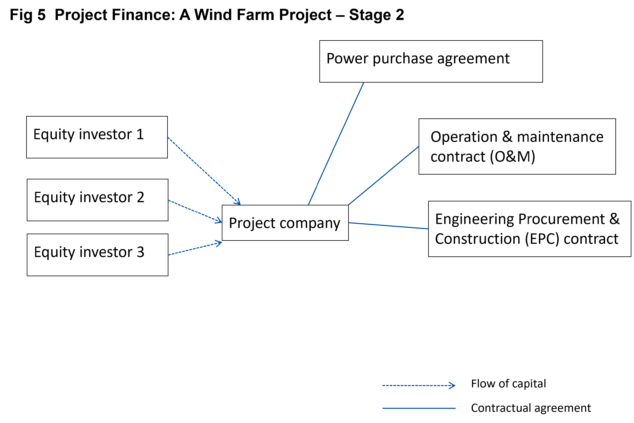
It’s not essential to have a revenue contract, you could just sell the electricity into the open market, but that would mean taking market price risk, implying a lot of revenue volatility. That would in turn make it hard to get the bank finance (the next stage). So in most cases, the project company needs to find one or more potential customers willing to sign up to pay for and receive the electricity produced once the wind farm is operational.
Note that none of the contracts is yet final, they are all contingent on the project reaching financial close (next stage).
Lastly, the equity investors bring the whole project to one or more banks to see if they’re willing to lend the project finance debt that will allow it to go ahead (figure 6). The bank will scrutinise all the moving parts and stress-test the assumptions (for example wind farms operate on the basis of P90 operating criteria, an estimate of how much they will generate in 90% of cases). The bank will try to get to the point where they can be confident of being repaid, with a margin of error, in all but the most extreme and unlikely scenarios. Nothing is ever 100% safe, but this scrutiny of the risks, who bears them and the overall robustness of the project, is part of what makes project finance both costly but useful. Banks occasionally screw up, as we all know, but in general project finance is a fairly safe form of finance. If the bank is not convinced it’s safe, the project will simply not get financed and will not get built.
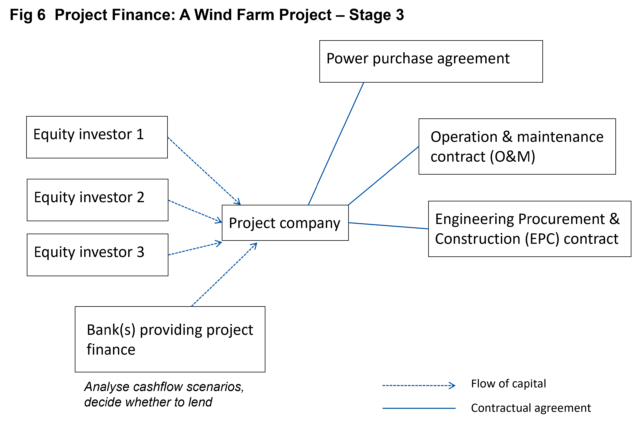
If the bank is satisfied with the project, it provides the debt and all the various contracts are signed, each cross-referencing the others, so the project’s various parts all stand or fall together. The bank should also check that all the counterparties (the companies signing the various contracts) are creditworthy, meaning they can actually meet their obligations. Any remaining risks can be insured, within limits, to try to reduce the risk of the bank not getting its money back on time to a negligible level.
The project cashflows are shown in figure 7.
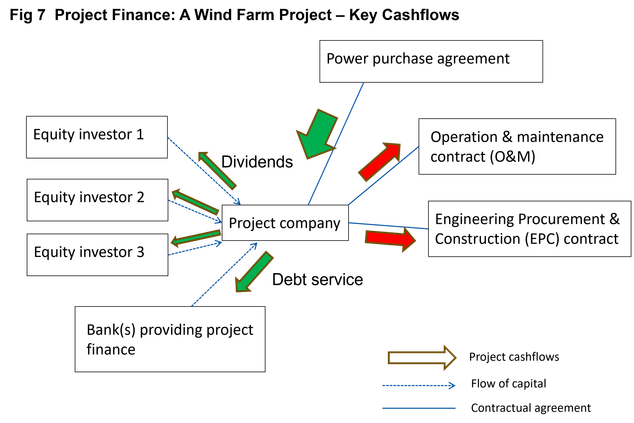
Note that if the project goes ahead and for some reason, there are not enough cashflows to pay the banks, the shareholders obviously get no dividends, but are protected from any claims on their funds, beyond the equity investment they have committed to. In legal terms, the banks have no recourse to the investors, who therefore have limited liability. This is sometimes described as investors having a “walk-away option”, meaning that the investors can dump the project if it gets into trouble, leaving it to the banks to see if what, if anything, they can reclaim from the assets.
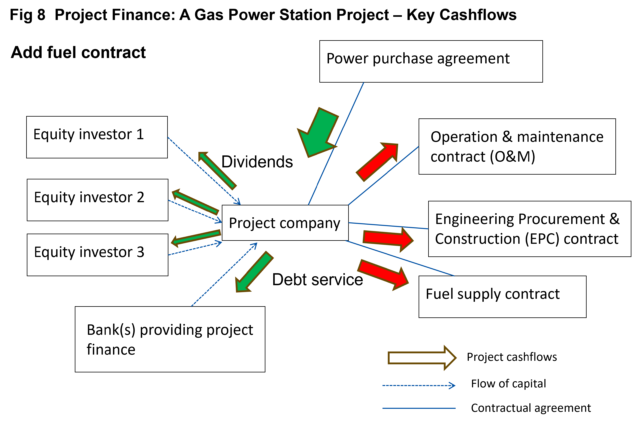
A final illustration is to imagine the project as a gas-fired power station (figure 8). The key difference now is that there is one more cashflow, namely the fuel cost. For a gas-fired power station, the project economics are tilted towards the two key variable items: revenue in and fuel costs out. If you can sign two contracts hedging both of those cashflows, ideally over the same time period, then the project becomes mainly a matter of operational risk (i.e. can you keep it operating enough of the time to at least meet the revenue obligations, and ideally a bit more to add some top-up revenue).
By contrast, wind farms and solar farms (and nuclear power plants) are largely driven by their fixed costs of equipment and construction, since after that their variable costs are relatively low.
Conclusion: costs and benefits
Project finance is more complex than standard corporate finance and so debt costs are usually 1-3 percentage points more than for an equivalent corporate loan. But project finance helps to ensure a well specified project where everyone is crystal clear on who bears the risks, and the risks are borne by those best able to manage them. Additional advantages are that it’s easy to involve more than one shareholder and to change the shareholdings (by agreement) in future.
Project finance is also used routinely in the upstream (exploration and production) oil and gas industry, where projects can easily run to tens of billions of dollars. Even the largest oil and gas companies are reluctant to take these projects onto their balance sheets, preferring to share the equity investment with two or three other oil and gas companies. Using project finance both protects the companies from an otherwise catastrophic financial risk, and allows them to invest in more projects than they otherwise would, providing diversification.
Things can go wrong with project finance, even with all of the scrutiny referred to above. One of the biggest fiascos in project cashflows was the Anglo-French Channel Tunnel Project, which began operations in 1997. Not only did construction costs come in around 80% over budget (£9.5bn compared with £4.8bn, and one year behind schedule), but traffic forecasts turned out to be hopelessly over-optimistic (about 3m passengers in the first year, compared with a forecast of 16m). The project flirted with bankruptcy, with the banks forced (partly owing to French government insistence) to put new money in. But shareholders still lost a large part of their investment and the banks had to write off part of their loans. Today the tunnel is a wonderful asset and an engineering marvel, now being used at levels close to those originally forecast. But it was not a happy experience for the investors.
*
(*) I realise this is strictly more like a sources and uses of funds statement, but I hope accountants will forgive the simplification.
Leave a Reply