

Infrastructure investment can be done successfully by both state and the private sector, there are plenty of examples of both. In this post we look at the USA and France for examples, some of which contrast with the general view of the USA as a largely private-sector driven economy and France as one largely state-driven.
*
Private finance: the Suez Canal 1869
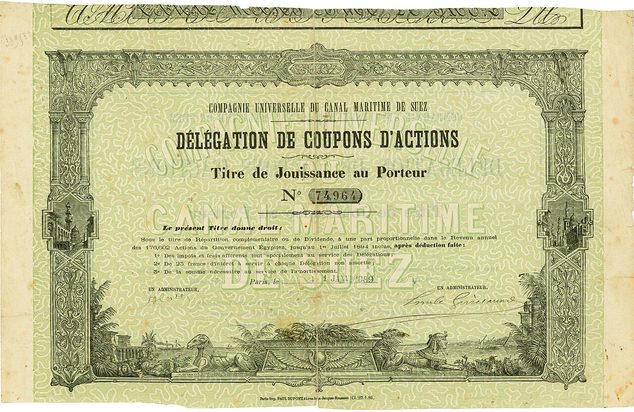
One of the most successful and celebrated infrastructure projects was the Suez Canal, opened in 1869, which was an entirely privately financed project, by a French company, though with support (and initial 44% ownership) from the government of Egypt (at that time a self-governing province of the Ottoman Empire). The canal itself belonged to the Egyptian government, with the Compagnie universelle du canal maritime de Suez (Suez Canal Company) owning a concession to operate it. Despite costs being double the original plan and early traffic levels low, the project was eventually a financial success, and Suez Canal Company shares received real returns of 8-9% or more (*). The Egyptian government had to sell its shares to the British government after it, in effect, went bankrupt in 1875.
Here is a Suez Canal Company bearer security issued in 1889.
Government finance: the Hoover Dam 1936
One reason for featuring the Hoover Dam is that it’s an excuse to share the wonderful photo by the great American photographer Ansel Adams (**).
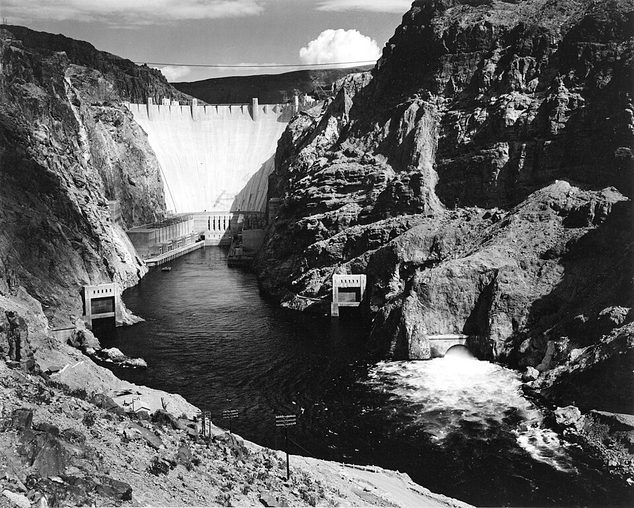
Designed to provide irrigation water and to generate electricity, the Hoover Dam was built in 1931-36. It was therefore constructed during the Great Depression, bringing much needed (but very tough and hazardous) jobs, and is often bracketed with President Franklin Roosevelt’s New Deal projects which began in 1932. But Hoover Dam was planned in the 1920s, before anyone knew that a depression was coming. It was inaugurated in 1928 by President Calvin Coolidge and paid for by the federal government, after a lot of political wrangling from politicians in the eastern US not wanting to pay for a project that would benefit only the western states. Even before the depression, there was (grudging) agreement that some projects should be supported by the government.
The dam was originally and controversially named after the next President, Herbert Hoover, who famously didn’t see a justification for state intervention in the depression . Not only was there a tradition of naming large projects after previous politicians, not incumbent ones, but Hoover was very unpopular at the time (shanty towns of homeless unemployed people across the USA were informally known as “Hoovervilles“). When the dam was completed, President Roosevelt renamed it back to the original name Boulder Dam, but Congress unanimously renamed back again to Hoover Dam in 1947.
An overview of ownership types
Figure 1 shows a simple division between state and private sector ownership, allowing for the various forms of state ownership, including historically non-state but centrally directed arrangements (kings, emperors, pharaohs, tribal leaders etc.)
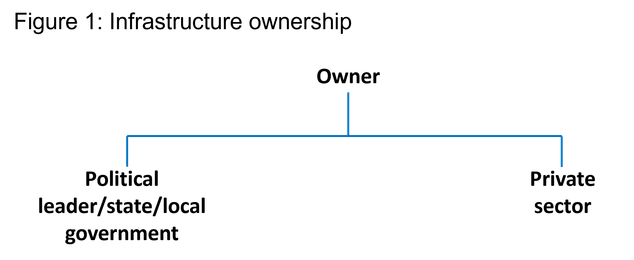
Table 1 shows the predominant ownership type for some key infrastructure sectors in the USA and France. I use France because many Americans appear to think that it is some sort of socialist wilderness, oppressed by high taxes and suffocated by government bureaucracy. France undoubtedly has its challenges, with protests and riots on the streets as I write. But it is a much more pragmatic place than its state-intervention reputation suggests.
By contrast, the USA has a reputation for less public sector involvement and a reliance on the private sector. Where infrastructure is concerned this is rather misleading.
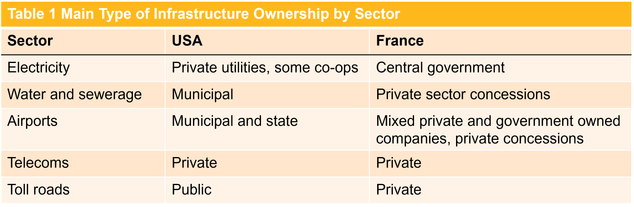
So we see that while the electricity sector in the US is indeed mostly in the hands of what are called investor-owned utilities, usually quoted on the stock exchange, water, sewerage and a lot of transport infrastructure are in the public sector. By contrast, France’s EDF (Electricité de France) was partially privatised for a while but that experiment ended with the 11% private shareholding being renationalised in 2023.
Water supply in France is mostly run on the basis of private companies holding long term concessions (in effect temporary ownership and management contracts) granted by municipalities which retain the ultimate ownership. So the services are provided by companies, not by the municipalities themselves. Aside from a few corruption scandals in the past arising from alleged bribes around the awarding of the contracts, this system has been effective and uncontroversial, although the city of Paris (by far the largest in France) remunicipalised its water system in 2010, owing to the belief that prices had risen too much under the previous private concession system.
By contrast water in the USA is very largely in the public sector, at the municipal level, with some state level projects for larger water supply. Again, so far as I know, this has been satisfactory and nobody is calling for privatisation of American water supplies.
I once took the CFO of the French water company Lyonnaise des Eaux (that company’s French assets were later merged into the company now called SUEZ) on a visit to several cities in the USA. He was interested in pitching Lyonnaise’s private sector water management services to USA municipalities, but received a cold, even suspicious reception. Americans couldn’t get their heads around the idea of a French private sector company offering to own and run American municipal owned water assets.
The same contrast between public sector ownership in the USA and private (albeit through long term concessions) is seen in airports and toll roads.
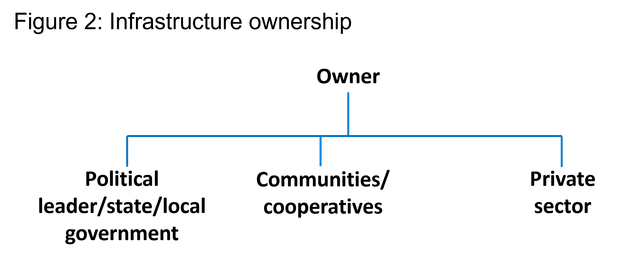
There are also community-based or cooperative/mutual infrastructure arrangements in many countries, so figure 2 adds that category to the typology.
An early example of informal, community-based ownership that has in some cases evolved into something closer to local government ownership is the dykes and polders of the Netherlands. Indeed some of the oldest active bonds outstanding were issued by Dutch water boards, and still pay interest.
In the US there is a long tradition of cooperative ownership of electricity and later telecommunication assets, though they form a small share of the total. There are also many mutually owned banks, called credit unions. When I worked at the World Bank, I had to join their credit union to get paid. These all demonstrate a tradition of community-based, bottom up civic activism that remains strong in the USA.
Conclusion: no unique best model
The point of this simple comparison is that the same type of infrastructure can be owned and managed in very different ways in different countries, and not in a predictable manner. There are many more examples of ownership variation across the world (railways are in the state sector in China, but privately owned in Japan for example). And there are hybrid models including public-private partnerships (PPPs) which mobilise private finance and management but for a public sector client.
So what makes for a successful outcome is not as simple as just getting the ownership right. In the UK in 2026 there is a widely held view that private ownership of water infrastructure and of the railways has been a failure. Railway operations are in fact gradually returning to public ownership.
But it’s unlikely that changes of ownership alone will fix the very real problems we face, especially in the sewerage sector. In fact London’s sewerage overflow problem, arising from population growth, a greater proportion of hard surfaces accelerating rainwater runoff, and climate change, should now improve owing to the new Thames Tideway Tunnel, a privately funded £4.5bn “super-sewer” that came into operation in 2025. The company that built and operates it is called Bazalgette Tunnel Holdings, named in memory of the engineer who built the original London sewer system – which was funded by central government.
*
(*) Hansen, Bent & Tourk, Khairy, 1978. “The Profitability of the Suez Canal as a Private Enterprise, 1859–1956,” The Journal of Economic History, Cambridge University Press, vol. 38(4), pages 938-958, December.
(**) I remember visiting The Ansel Adams Center for Photography in San Francisco many years ago and marvelling at his photos. Sadly, that gallery closed in 2001. There is a permanent gallery in Yosemite, where he took some of his most famous photos.
Leave a Reply