

The main investors in private sector infrastructure assets are institutional investors, meaning the usually large organisations that mobilise savings from ordinary people and invest them on their behalf. Although currently only a small fraction of their assets goes into infrastructure, their collective size means that this still amounts to a large flow of funds.
*
Governments around the world are typically pretty constrained these days, owing to high levels of debt and rising future obligations for ageing populations, including the health and care costs of those older people. So there is a big emphasis on mobilising private investment for other important needs such as infrastructure. Most private investment is made by the big institutions that combine the savings of large numbers of relatively ordinary people. There are four main types, if we include sovereign wealth funds, which are often funded by a share of national taxes or by royalty payments on extractive resources such as oil (see table 1).
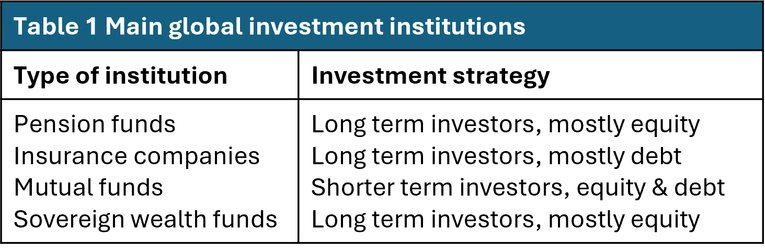
Loosely speaking, these main categories of financial institution own most of the world’s wealth. Their investment strategy arises from what they’re trying to achieve: pension funds seek to grow their assets in real terms, over decades, to provide a retirement income for their clients, so they need growth assets such as equities. Sovereign wealth funds, while not usually having a specific maturity or end investment date, also look for long term growth. Insurance companies’ liabilities are usually in nominal, not real terms, so they usually invest in debt securities or loans, which provide reasonably secure nominal cashflows, often years into the future. Mutual funds are much more varied: some aim for longer term growth, but others are more of a shorter term savings vehicle looking to avoid too much risk.
Of these four, pension funds and sovereign wealth funds are the natural providers of long term equity capital, while insurance companies are the natural providers of debt capital. Mutual funds may be occasional investors in infrastructure but are not natural investors in infrastructure assets.
We’ll focus on equity investment for the rest of this article, as that is the scarce capital. Once a project or company has equity investors, it is not usually too hard to find lenders for the debt, whether banks or financial institutions. So, why might infrastructure assets be appealing to long term equity investors like pension funds, compared with all the other options they have, like investing in the general stock market?
Table 2 lays out some of the typical economic characteristics of infrastructure assets. Not every infrastructure project has all of these but it’s a reasonable summary of what makes something an “infrastructure” asset rather than just a generic private sector investment asset.
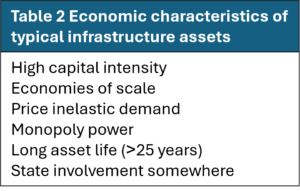
A classic natural monopoly infrastructure asset such as electricity transmission fits all of these: it is very capital intensive, benefits from scale economies, customers have very little choice but to use it so there is inelastic demand, there is usually no competing source of supply, providing monopoly power and the asset may last for many decades. Owing to the obvious risk of abuse of monopoly power, such an asset will be regulated, which brings in the risk of state interference or political risk. A more credible and independent regulator will be seen as an acceptable risk, but one perceived as liable to cut prices or otherwise yield to political interests may not.
These economic features translate into a set of financial characteristics which provide a template for a potential investor to consider how such an asset might fit into their portfolio (table 3).
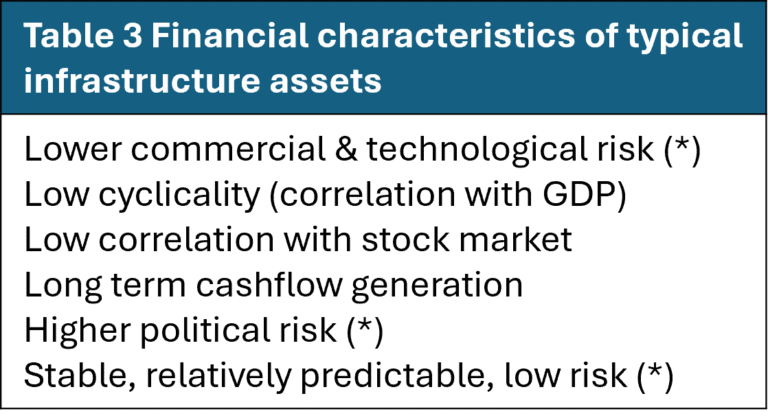
The bottom line is that infrastructure assets can be long term, stable and relatively low risk generators of cashflows. If they provide some growth too, which is often the case, they are a good fit with the needs of pension funds and sovereign wealth funds.
Another point to make is that most infrastructure assets are owned in the form of private companies, meaning the shares are not listed and therefore hard to trade. In other words, they are illiquid. This is a disadvantage for investors such as mutual funds, which do not usually want to be forced to hold their investments for the long term. But for natural long term investors such as pension funds, this illiquidity is not a problem. In principle, the illiquidity is a disadvantage that should generate a small additional return to compensate. This “illiquidity premium” exists in theory, but it’s not so clear whether it actually exists in practice.
Figure 1 shows how infrastructure fits into the typical asset allocation of a large pension fund in advanced economies.
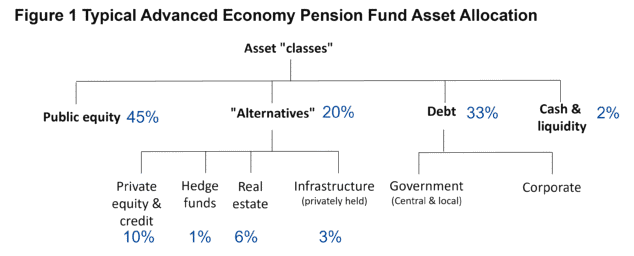
You can see that infrastructure in the form or privately held equity in either projects or utility companies is only 3% of the total assets of a typical big pension fund. The fund may own shares in publicly quoted utility companies, which would be included in the 45% allocation to public equities, but it would still be pretty small. Some assets are hard to classify, and might show up under real estate or private equity. But it’s still clear that most big institutional investors don’t put much of their clients’ funds into infrastructure.
There are a few exceptions, chiefly large pension funds in Canada and Australia, where the allocation is far higher. In both cases, the funds have built long experience with investing in infrastructure assets, both at home and abroad and are often the main investors in new infrastructure projects, sought after precisely because of their expertise and credibility, which may entice other investors.
So why don’t most institutional investors allocate more to infrastructure? Table 4 gives some of the main reasons they cite.

Large infrastructure investment almost always have some state involvement, and many investors feel ill-equipped to measure or manage this risk. They’re especially reluctant to invest in new build or “greenfield” investments because of the construction risk, which is itself vulnerable to political interference (changes in the scope of the project, additional environmental conditions, local opposition and so on).
Even if the fund can get comfortable with these risks, it will usually need to hire a specialist team to deal with them, who are familiar with the assets (bridges, energy, roads etc) and the additional complexity of the financing. These skills go beyond the normal investment analysis that pension funds and sovereign wealth funds usually claim to have. A new team is expensive, and only worth hiring if the fund expects to make a material investment in infrastructure.
Another way of investing, without the expense of hiring a team, is to go through a third party investment fund, which has the expertise and acts as an intermediary. But this inevitably adds to the fees and will lower the net return on the infrastructure asset. Since we’d expect infrastructure returns to be relatively low n any case, given that they are usually low risk assets, the extra fees weigh heavily and may remove the investment case.
Pension funds are cautious, highly regulated investors, and slow to change their policies. There is tentative evidence that they are increasing their asset allocation to infrastructure but it’s not showing up yet in a major way.
*
Additional reading: https://www.preqin.com/academy/lesson-4-asset-class-101s/infrastructure
Leave a Reply