

In this article we look at the different ways of financing infrastructure. The key point is that there is no single best way of investing in infrastructure, it can be done through the public or private sector and through a variety of investment methods. We can see from examples that many different approaches can work.
First, let’s look at the general financing question from the point of view of who is looking for investment funds? The diagram below first divides between the public and private sectors, then goes into more sub-divisions. It includes the supranational sector, which broadly speaking means development banks. Although a small part of the global financial system, it plays an important role in infrastructure investment.

Figure 1 distinguishes national and local governments, because a lot of infrastructure naturally arises at the city or state level and is still often owned and managed there.
It also shows that private sector finance can be divided into financing companies and financing projects. Simply put, a company is an organisation that owns and manages a range of projects, such as an electric utility that owns several different power plants and also distributes power to household and commercial customers. When investors provide financing to the utility company they are, in effect, financing the whole portfolio of assets and have no particular interest or financial claim on any one of them.
A project is a standalone investment asset such as a dam, a solar farm or a toll road. Each project is owned by a company set up specially for that purpose, but the company does nothing beyond that project. It is the project company itself that raises financing and the providers of that finance are depending on the project asset to generate the cashflows to pay them back.
The diagram below puts some labels and further detail on our financing scheme. The branch of finance that funds the public sector is known as public finance and has a close link to tax and fiscal policy. Financing companies that are already reasonably established is called corporate finance and is the single largest part of private finance. We can separate out the financing of new and start up companies, which is usually called entrepreneurial or new venture finance.
Lastly we show project finance, which is the financing of individual projects. While small compared with corporate finance, project finance is very important for infrastructure and is the most common way in which larger infrastructure investments are done.
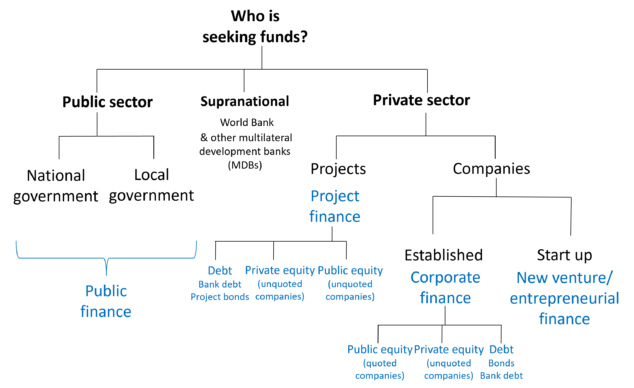
Figure 2 shows that private finance comes in two generic forms: debt and equity. We can make a further distinction between equity in companies that are quoted on a stock exchange, public equity; and equity in companies that are not quoted, called private equity. Equity in a company or project is either public or private, it cannot be both.
Debt comes from two sources: banks and bond markets. A company, or a project, can borrow from both. Generally speaking, infrastructure uses a lot of project financing debt, the bulk of which comes from banks. Project finance is a specialised role within banks, reflecting its greater complexity, long maturity and the specialised nature of the assets being financed.
Examples of financing: 1) public sector
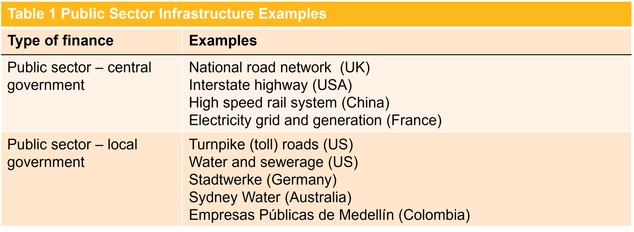
This may all seem a bit abstract, so let’s look at some examples. Table 1 shows some examples of infrastructure assets in the public sector, both at the national and local level. Federal countries like the US and Germany have a long tradition of local level, usually municipal, provision of electricity, water and sewerage services. These used to be mainly run and owned by cities in the UK too, but were nationalised and then privatised in the late 1980s. In most countries the main long distance roads are in the state sector but there are cases of toll roads, which can be in either the public sector (in the US usually state level) or privately owned. The UK has a single toll road, which is unpopular, despite the UK having pioneered private toll roads in the form of turnpikes in the 18th century – the name lives on in the eastern part of the US.
Examples of financing: 2) private sector
Turning to private sector investment, this can come in many different ways: debt or equity in both individual projects or in companies. Figure 3 below shows the different channels of private investment into infrastructure.
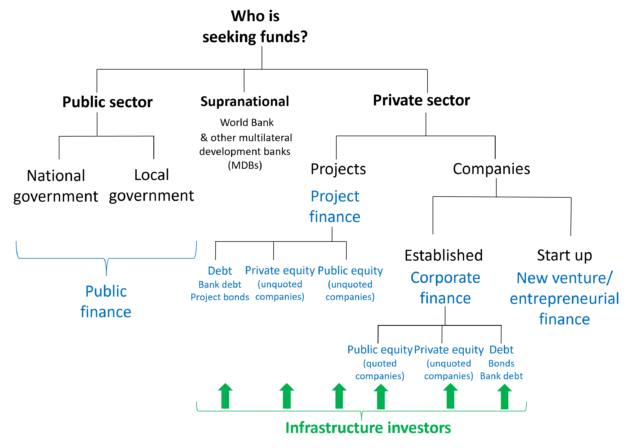
Table 2 below shows examples of the different channels. Single project public companies, meaning a company with shares traded on a stock exchange, but investing in a single project, are relatively rare but there are some notable examples. The original Universal Suez Canal Company, based in France, successfully and very profitably funded the construction of the Suez canal. (The canal opened in 1869, the same year that the US transcontinental railroad was completed, also funded privately, though with a lot of government support through land grants).
By a series of steps and historic quirks, those original Suez canal shares live on, indirectly, in the shares of the French/Belgian utility company ENGIE, whose predecessor was named GDF-Suez (GDF stands for Gaz de France, whose origins were municipal, later nationalised, then partially privatised). ENGIE, whose shares are quoted on the Euronext stock exchange, is an example of a publicly quoted utility company, though its largest shareholder is the French government (which owned most of GDF before its merger with Suez) (1).
Eurotunnel was listed in the UK and France in 1987 as a way of financing the Channel tunnel. Unfortunately that project saw costs come in far greater than budget and revenue far below, so the company had a major restructuring in 2007. The shares live on in the form of the company Getlink.
Much more common is where a single project company’s equity is not quoted but held privately, usually by a small number of major investors. The table shows two recent UK examples which have in common that they use UK government risk protection, and in the case of the nuclear power project Sizewell C, government ownership of some equity too. But there are very many infrastructure project companies round the world, including public-private partnerships (PPPs), in which a consortium of private investors builds and operates an asset for a public sector client (the World Bank affiliate IFC is a major supporter of PPPs).
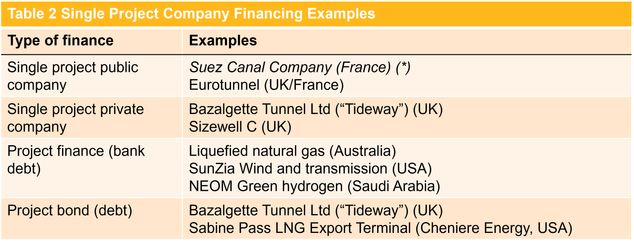
Table 2 also shows that project debt can come from a bank, where it is usually just called project finance, or from selling bonds that are claims on the project company. Project bonds are relatively rare compared with bank project finance, but they do exist and the London super-sewer company Bazalgette Tunnel issued some, as did the Sabine Pass Liquefied Natural Gas export terminal at Sabine Pass.
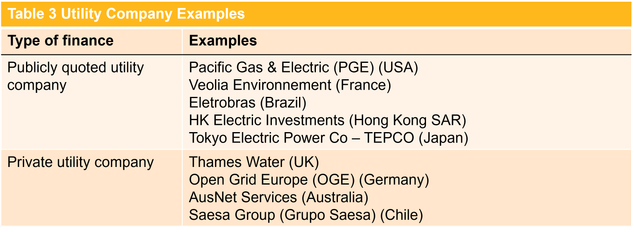
Lastly, in many countries a lot of infrastructure is owned and run by utility companies (table 3). Most of these are, or were originally, listed on stock exchanges. This is common in Europe, following a wave of privatisation in the 1990s and 2000s. It is also found in many emerging market economies, especially in Latin America, where there was also a wave of privatisation in the past, led by Chile and later followed, under some pressure from the US government, IMF and World Bank (the so-called “Washington consensus”) in other countries.
In the US, while the water sector remains largely in the public sector, the electricity sector is mostly owned by publicly quoted electric utilities (there are also many cooperatives, but their overall share of electricity is relatively small). Electricity in Hong Kong has been run by two publicly owned utilities for many decades, one of which is HK Electric. TEPCO in Japan is a publicly quoted company that is better known than it would like to be, as the owner of the Fukushima Daiichi nuclear power plant that suffered an accident following the tsunami of 2011.
Some public utilities were later taken private, meaning that one or more investors bought the equity and took them off the stock exchange. Pioneering infrastructure investors in Canada and Australia, together with some sovereign wealth funds, have been major owners here. Some private utility companies were never quoted, but set up as private companies from the start.
One controversial example is the company that provides water and sewerage services to the greater London area, Thames Water. Originally a municipal corporation, itself merged from various local operators, Thames was privatised and listed on the London Stock Exchange in 1989. Later it was taken private by a group of investors and then sold on to other investors, all the time taking on more debt. As of late 2026 the company is widely unpopular with customers owing to alleged operating failures, is in financial difficulties and faces the possibility of either temporary government control (“special measures”) or even renationalisation (currently popular with the general public). To be fair, many other privately owned utilities have operated just fine and without controversy.
Conclusion
From the variety of different ownership and financing approaches, it should be clear that infrastructure finance is broad and varied. There is no obviously best way of getting projects built and run. Example of success and failure exist across all of these different models. What works in one country won’t necessarily work in another with different economic, legal and cultural foundations but there is a lot to learn by studying the full range of infrastructure financing experience.
*
(1) France has privatised some of its state owned infrastructure assets but, unlike in the UK, rarely given up complete ownership or control. Through multiple voting shares, the government controls about one third of the votes on the ENGIE board, though owning only 24% of the shares. For a while, the state electricity company EDF was part privatised in 2005, but that experiment was ended in 2023 when the government re-acquired all shares and it reverted to being a state-owned corporation.
Leave a Reply