

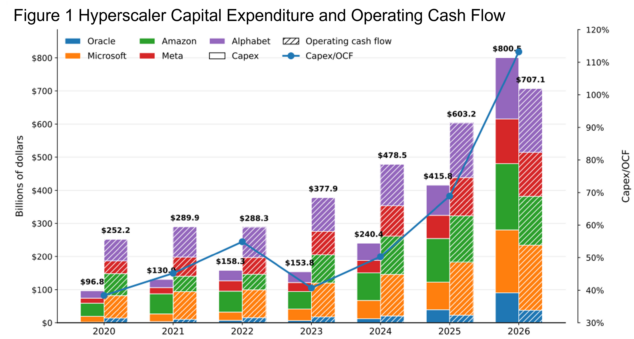
Data centres are a new(ish) form of infrastructure investment that because of the sheer scale of AI-related investment are getting a lot of attention. Data centres are not new but what is somewhat new is that they are increasingly be financed off the balance sheet of the big tech companies (the “hyperscalers”) that need them. This is mainly owing to the enormous capital spending on AI that exceeds the operating cashflow of those hyperscalers (see figure 1).
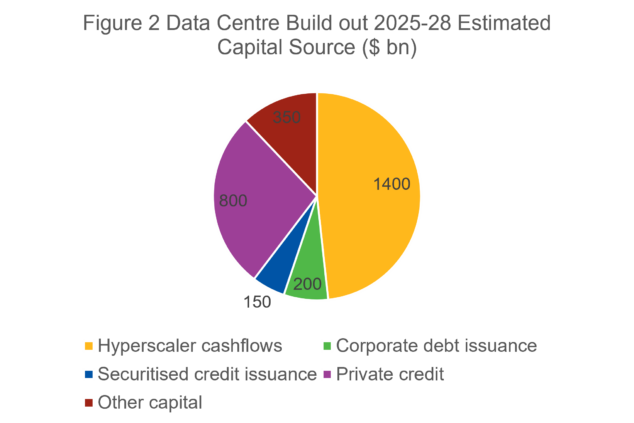
Forecasts for capital spending suggest the gap is set to grow enormously (see figure 2 for Morgan Stanley projections of how it will be financed).
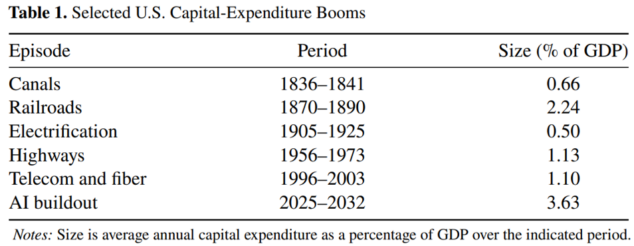
The expected scale of overall AI capex is, according to some forecasts, set to exceed even the railroad investment boom of the 19th century (Table 1).
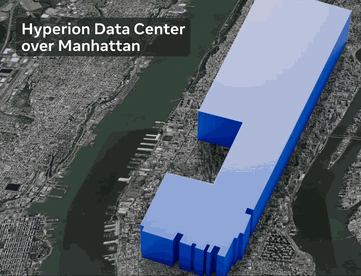
Rather than take on a lot more debt on their balance sheets (which is normal corporate finance) these companies for the most part prefer to remain relatively unlevered and “asset-light”, so they are using off balance sheet vehicles to raise debt in a way more like traditional project finance. One deal that has got a lot of attention, owing to its size (comparable to Manhattan according to Mark Zuckerbergy) and innovative structure, is the Hyperion data centre project in Louisiana, sponsored by Meta (figure 3). Note that sponsored is not the same as owned or controlled, as we shall see. This project has set the pattern for later projects but, as it is well documented, we’ll focus on it for this post.
Meta is a big company with a lot of financial resources, so why didn’t it just make Hyperion a corporate project and borrow on its balance sheet to finance it? Figure 4 shows the schematic outline of what this would involve.
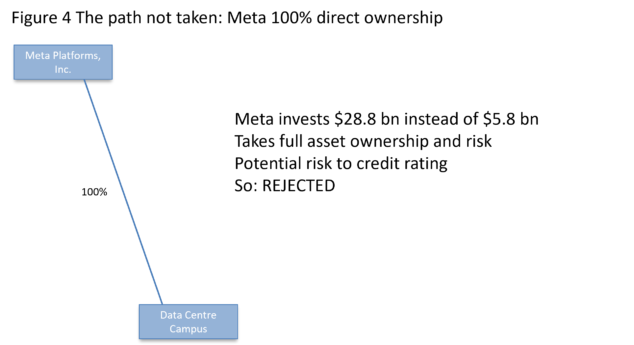
Meta clearly didn’t want to become a more leveraged, more traditional capital intensive company. Perhaps it worried that would change the way investors perceived it and its financial risks. So instead, we get the project shown in figure 5, based on S&P credit rating analysis of the debt raised to finance the non-Meta part of the project.
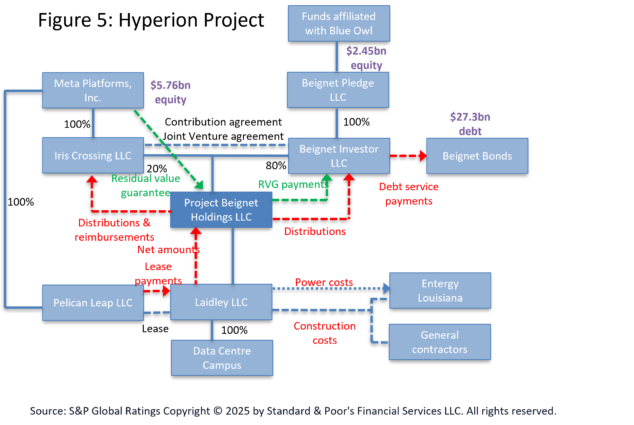
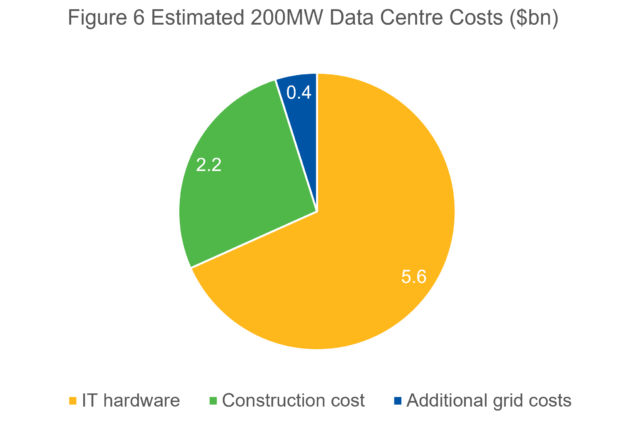
This is pretty complex and bewildering, so let’s break it down. First, Meta’s goal is to procure data centre capacity, not to be the landlord or manager of the site, nor to take on a lot of debt on its own corporate balance sheet. But it had to make some commitments to induce other parties to take on the management and financing of the data centre campus (Meta separately undertook to buy the IT hardware, which is actually the bigger part of the total project cost, see figure 6.)
The project is set up as a joint venture, with Meta owning 20% of the equity (so it doesn’t consolidate the project on to its balance sheet), and a new company called Beignet Investor LLC taking the other 80%. We’ll say more about that party later. The two partners own a new, special purpose company called Beignet Holdings LLC, which through a management company Laidley LLC, will own and manage the data centre campus (figure 7).
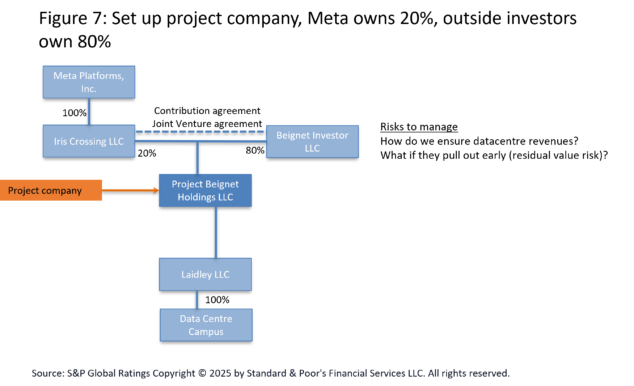
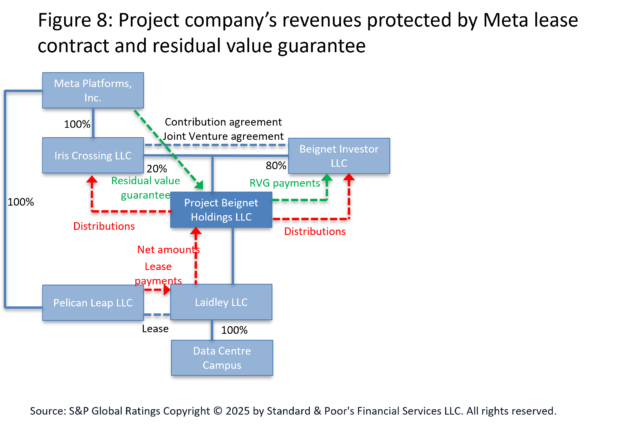
The 80% investor and joint venture partner would presumably have some concerns about protecting their investment. First, how do they ensure a flow of revenue to the data centre? And second, what about the risk of the asset value in future, especially if the revenue dries up? Both of these risks are managed by Meta. First, Meta signs an operating lease, through a 100% subsidiary called Pelican Leap LLC. Second, Meta provides a residual value guarantee (RVG) which protects the other investor’s investment (see figure 8). These are both commitments by Meta, but cleverly structured to avoid showing up as debt or other liabilities on the Meta balance sheet (though they are disclosed in Meta’s financial reporting).
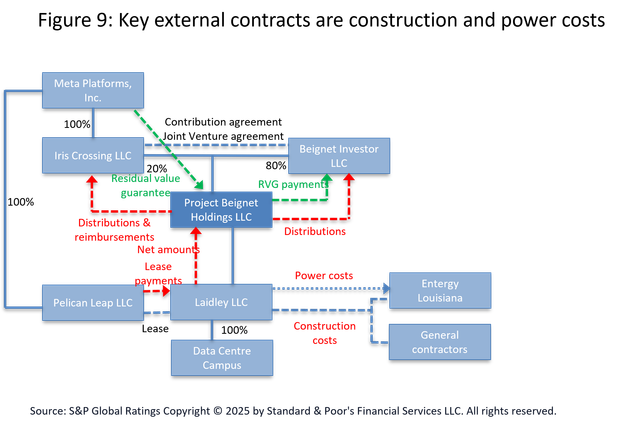
The other main risks of the project are construction and then energy supply, both of which are contracted with third parties (see figure 9). Note that Meta itself takes the construction risk, not the project holding company.
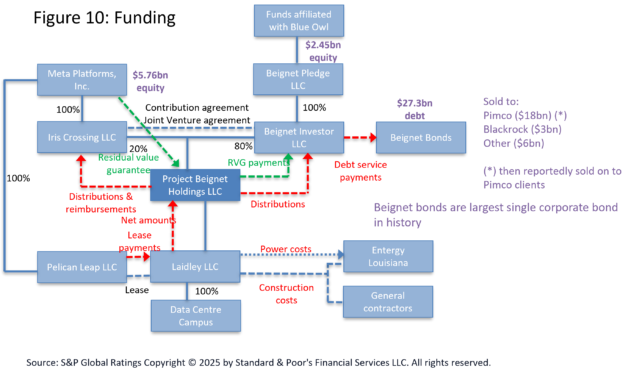
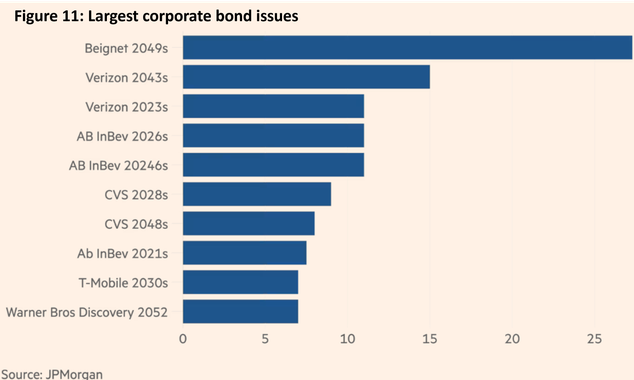
Finally, let’s fill in the full financial picture. Beignet Investor LLC, the non-Meta investor in the data centre project, receives $2.45bn of equity from its ultimate owner, institutional investor Blue Owl and its affiliated funds, plus debt of $27.3bn, which was raised in what was the largest ever corporate bond issue, mainly from Pimco and Blackrock, two other large institutional investors. S&P rated that debt A+, which is investment grade, meaning generally pretty safe.
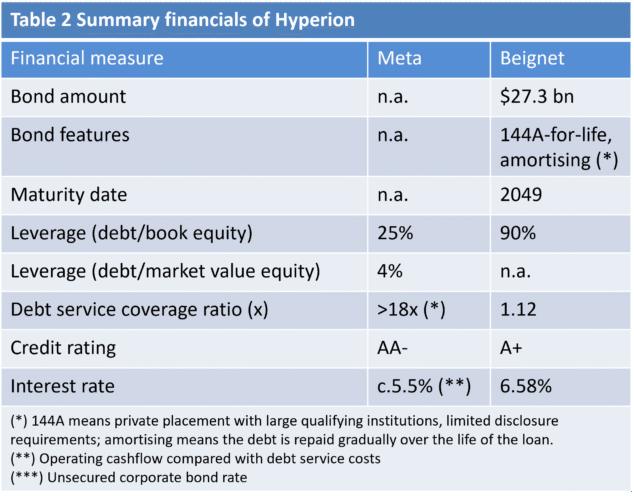
That rating was one notch below Meta’s own corporate debt rating of AA-. Why? Well the lenders don’t have a direct claim on Meta’s balance sheet, only the indirect claim based on Meta’s contractual commitments. The new project debt interest rate was 6.58%, about 1 percentage point higher than Meta’s own cost of corporate debt. So all of this complexity and risk management comes at some cost, but presumably is worth it from Meta’s shareholders’ point of view (see figure 10).
The bond issued by Beignet holdings runs until 2049, which is when the lease payments contracted from Meta cease. It’s an amortising bond, meaning that the principal (the amount borrowed) is repaid gradually over the life of the bond, rather than at the end in a “bullet” repayment. The full financial details are shown in table 2.
Conclusions on the Hyperion project
So what’s notable or interesting about all of this? This structure, which looks complicated, is actually just a variation on the typical project finance arrangements for infrastructure assets. There is a special purpose company set up to own the project, the external shareholders have liability limited to their equity investment, with the debt owed by the project company, not by those external investors, and the overall project is highly levered. The complexity and the fact that the external lenders have no direct claim on the balance sheets of the investors means a higher interest rate than for a normal corporate bond, though in this case not much higher (project finance can often cost two percentage points more than corporate debt).
It’s not entirely standard because project finance usually comes from banks, but in this case the debt is in form of bonds.
The project is structured to avoid Meta having much debt on its balance sheet, but it does have a lease obligation. Although this looks a lot like debt, it’s broken into five successive four-year leases, which through the magic of US GAAP means it doesn’t appear as a debt-like liability on Meta’s balance sheet.
Special purpose vehicles that allow off-balance sheet financing have something of a bad name owing to their role in the hidden leverage that led to the bankruptcy of Enron in 2001 and in the various ways that banks kept mortgage assets off their balance sheet leading up to the financial crisis of 2008. There have been some sceptical commentaries on this whole deal, worrying that we are about to see a wave of “hidden” debt that will contribute to a financial crash when the whole AI bubble bursts.
Clearly the likes of Pimco and Blackrock (and S&P) seem relaxed at present about the largest corporate bond issue in history (figure 11).
The Financial Time’s Alphaville section, a sort of off-balance sheet part of the paper, looked at the Hyperion deal and points out that it is quite rare for a bond of this size to have only a single credit rating. They also point to the wider concerns in credit markets about this sort of of deal, though at the time of writing the bond had traded up a bit from its issue price. More recently it has traded down, but of course interest rates have risen and in any case this is probably a thinly traded security.
Somewhere in Alphaville, I’m afraid I can’t find it, Robin Wigglesworth (whose recent book A Fabulous Debt, I strongly recommend) writes something to the effect that equity research analysts only bother to talk to their credit colleagues when it is obvious that something is amiss, which is to say that it’s too late. That certainly fits with my own experience of the near-invincible optimism of equity markets refusing to be deflected by a gloomy (but, alas, correct) credit report.
But perhaps this time it’s different.
*
Further reading
StijnVan Nieuwerburgh (Sep 2026) Financing the AI Buildout, Brookings Institution,
Advait Arun, (November 2025) Bubble or Nothing? Center for Public Enterprise
S&P Global Presale: Beignet Investor LLC, (17 October 2025)
Robin Wigglesworth “A closer look at the record-smashing ‘Hyperion’ corporate bond sale” FT Alphaville (30 October 2025)
Leave a Reply