

Railways, especially urban metros, light railways and trams, have high construction costs and it can be hard to charge enough in fares to cover these, on top of the operating costs. Either governments have to subsidise the project to cover the losses, or the project may not go ahead at all. One solution is to finance the project by capturing some of the increased land value (“land value uplift”) created by the project.
*
Railways have high construction costs, especially when being built through urban areas. It can be hard to charge enough in fares to pay for the operating costs, let alone the construction costs, particularly when part of the goal is to attract passengers away from driving, in which case high fares defeat the purpose. Once introduced, there can also be political pressure to keep fares down.
Urban systems are especially costly owing to the cost of land, the higher cost of construction and the need for high peak capacity to meet rush hour demand. According to a World Bank report from 2015, “Most of the world’s urban mass transit systems
cannot cover operating costs, let alone capital expenses, through farebox revenues”. The Geography of Transport Systems agrees: “Very few public transit systems worldwide generate enough revenue from fares to cover operating expenses. This is even more challenging if capital costs, such as infrastructure investments, are considered.”
There are some exceptions, in parts of Asia, where the urban density is high and commuter use of railways is higher than in Europe. Unusually for a European subway system, the London Underground more than covers its operating costs, which is partly because its fares are among the highest in the world.
Social value versus private value
Financial losses make it hard to justify building a new railway, tram or subway system. Even if there is a good economic case, the question remains of how to fund it. In many cases, the local or national government will accept the need for a subsidy, but state financial pressures may limit the scope of new projects and create a permanent drag on local finances.
Railways are a particularly tricky example of projects that may have a high social net value but fail to generate the cashflows to sustain private construction and ownership.
In a different post, I showed how governments should use social cost benefit analysis to evaluate new projects. In that case, I looked at a road, but the approach works equally well for a possible new railway. Here’s an amended version, showing the improvement in land value as one of the benefits of the project (figure 1).
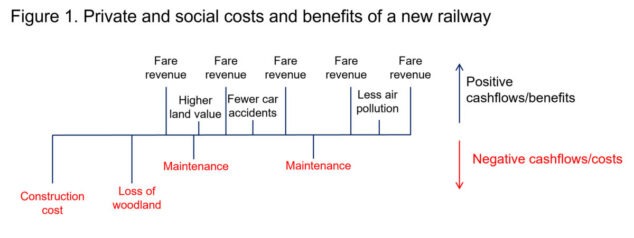
Figure 1 shows that the railway would, like any project, have a construction cost and operating costs, and some level of revenue from fares. These are all costs and benefits that would be taken into account by a private investor.
But there are also social costs and benefits. This railway project is assumed to mean a loss of woodland, something especially valuable in a country like the UK, which has already lost the great majority of its original forest. And it takes many years to grow a new tree. Although this may not lead to any direct financial cost to anybody, it is a social cost, something that citizens care about and should be reflected in the project analysis.
But there are also social benefits. If we assume the railway will lead to fewer car journeys (in other words, transport diversion takes place) then we can reasonably assume fewer car accidents, roads being far more dangerous than most other forms of transport. There will also be less air pollution, assuming that for the time being many of the cars will still use internal combustion engines.
We might also estimate a rise in the value of land near the new stations, for both residential and commercial property. This may be somewhat offset by a fall in the value of any properties that are too close to the railway line, where the noise may cut the value of houses. Let’s assume that the overall effect is positive.
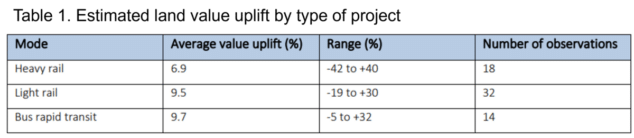
The government can, and should, take these wider social costs and benefits into account. The land value improvement may be large, especially for a brand new railway that offer far improved access to a town that previously lacked it. This benefit could be quite large relative to the project. Table 1 shows estimates from an OECD report, where the average uplift for light rail projects is 9.5%.
International Transport Forum, Paris. https://www.itf-oecd.org/sites/default/files/repositories/public-transport-land-value-capture.pdf
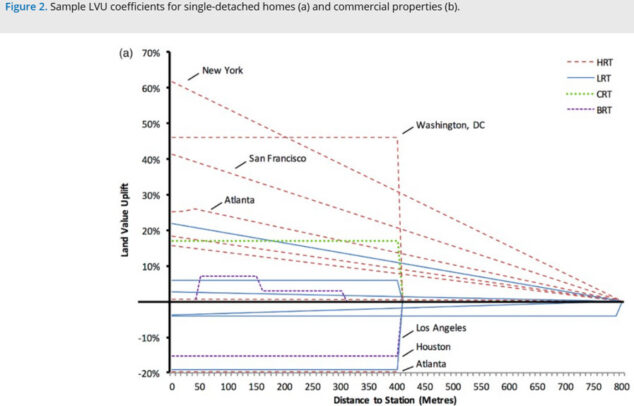
Research on the US gives a measure of the (mostly) positive effect on different types of property, depending mainly on their distance from the new stations (figure 2).
Source: Source:Higgins, C. D., & Kanaroglou, P. S. (2016). Forty years of modelling rapid transit’s land value uplift in North America: moving beyond the tip of the iceberg. Transport Reviews, 36(5), 610–634. https://doi.org/10.1080/01441647.2016.1174748
The only problem for the government is that this land value increase benefit is an externality – it will benefit other people, unconnected with the railway project. These people may be delighted with their windfall, but that extra increase in value is not directly available to the government. Unless the government can find a way to capture some of this land value increase, it won’t help to pay for the project.
In that case, if the government goes ahead, the project may well have a notional positive social net value, but the actual cashflows will be net negative; there won’t be enough new fare income to pay for the construction and operating costs, leaving the government with a need for permanent subsidy.
Capturing land value uplift
A possible solution that makes the project viable without subsidy is for the government (or a private developer) to capture the external benefit in land value rise. This would seem both fair and efficient:
i) it’s fair because those people benefitting from the land value increase did nothing to earn it; it’s just a lucky windfall
ii) it’s efficient, because it is internalising an externality, linking the land value increase (benefits) to the investment that created them (the costs). In a theoretically perfect market world where externalities were replaced by complete markets, the railway project would be able to charge the property owners but this is very hard in practice.
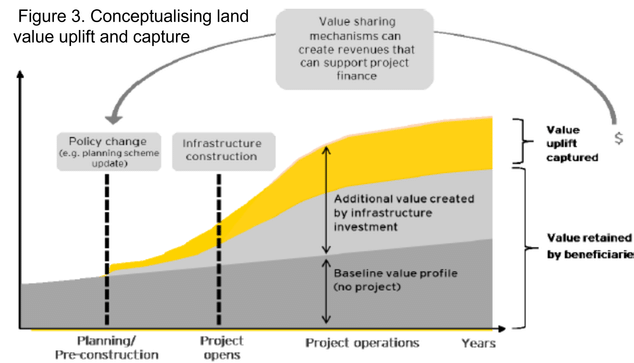
The concept is shown in figure 3.
Transport Forum, Paris. https://www.itf-oecd.org/sites/default/files/repositories/public-transport-land-value-capture.pdf
This is not a new idea. Indeed, many privately funded infrastructure projects where made viable by grants of land, the value of which would rise once the project was built. An early example was the US Federal Government granting some of its vast property as canal land to the states of Indiana and Ohio in the 1820s. The land was for building a canal from Lake Erie to the Wabash River, to allow shipping from the Great Lakes to the Mississippi River basin. But additional land either side of the route of the canal was intended to be sold to help pay for it.
The US Land Grant Act of 1850 began the process of making Federal Government land available to the states to support railroad construction (and ranching and mining). Initially 3.75m acres, the total reached 21m acres by 1875.
The Canadian Pacific Railroad, built across the entire country between 1875 and 1885, received 100,000 square km of land, plus tax breaks and financial contributions from the Canadian government, such was the importance of the railway to opening up the western provinces to new settlement (leaving aside the fact that some of it was already inhabited). Canadian Pacific then sold the land, as part of a package including steam ship to Canada, to overseas immigrants.
The first of several Australian land-grant railways was the Midland Railway of Western Australia in 1886. For each mile of railway built, the company received 12,000 acres (4,900 ha). The company was later listed on the London Stock Exchange.
In Japan Hankyu railway pioneered what later became known as Transit-Oriented Development (TOD) in Osaka in 1910. This began a long tradition, right up to the present, of developing housing and commercial real estate around railway stations, which can generate more revenue than the fares paid by passengers.
The London Metropolitan Railway, which operated lines linking north west London to the centre, bought land around the route of its tracks and then developed housing there, starting in the 1890s and on a large scale in the 1920s. Estates at Harrow, Wembley, Pinner and Rickmansworth gave rise to the name “Metro-land”, a whole area of suburban development that extended London’s built up area far into the north west. Metro-land was part of the wider house-building boom of the UK inter-war period, but mainly in the south of the country.
It’s also possible for the project developer to buy the land in advance, before anyone else realises that there is a future prospect of land value increase, though there is obviously a risk that the secret leaks, leading to speculative buying by others. Alternatively, the government can permit forced purchase at prices before the development value raises the price.
An example of how this can work is the Tsukuba Express Line in Tokyo, which opened in 2005. The project was allowed to compulsorily buy land along the route and zone it for new development (**). The total increase in land value was in some $2.2-3.1bn, part of which was used to pay for the $0.6bn construction costs of the project, which became fully profitable within five years of opening.
Another notable example is the Hong Kong MTR system, which started in the 1970s as a government statutory corporation but was partially privatised in 2000, with the government remaining the largest shareholder. The original goal was that property development at and around stations would contribute about 20% of total revenues, but this has moved up to nearer 40%, reflecting the difficulty of making the system pay from fares alone.
The legal basis for compulsory purchase runs up against the historically strong protection of private property in places like the US and UK. The case for government compulsion needs to be strong in both cases. Some projects manage to tap voluntary contributions from private property developers who, in their own self interest, want a project to go ahead. But if they believe it will go ahead anyway, they have the incentive to free-ride and not pay anything.
London’s recent, highly popular Elizabeth Line (originally called Crossrail) which opened (late) in 2022, is a public sector project, owned by Transport for London (TfL), which is owned by the Greater London Authority. Most of the funding for Crossrail came from public sources, including additional business taxes. But there were some contributions from the private sector, including the Canary Wharf property owner, housebuilder Berkeley Homes and (privately owned) Heathrow Airport (see figure 4).
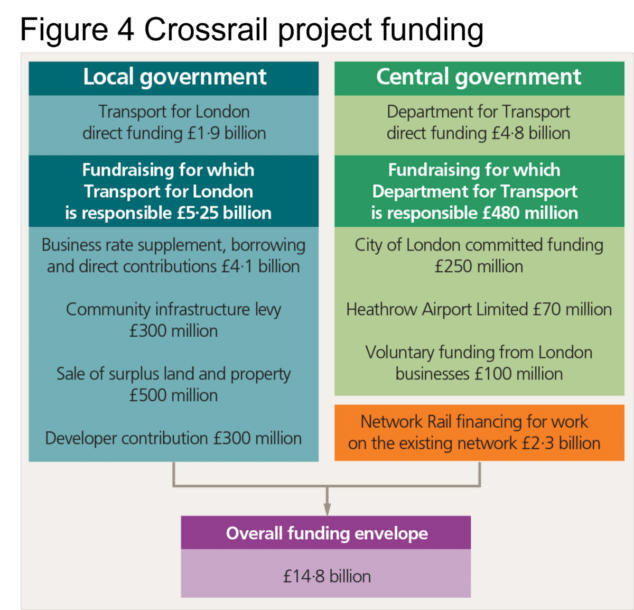
Figure 4 shows that the great majority of the funding came from public sources, even though the Elizabeth Line has created a lot of land value along its route. TfL captured some of the external benefits in two forms. Firstly, a business rate supplement (a form of local property tax) was charged, for a finite period, to allow TfL to borrow £4.1bn. This was a rather blunt tax, levied on non-domestic properties across London.
The second part was in the form of a “community infrastructure levy” on new commercial development close to the route of the new line. This is a form of land value uplift capture, but at £300m, made a modest contribution to a project which eventually cost £18.9bn, compared with the original target of £14.8bn (the government estimated a total net benefit to the UK economy of £42bn).
Conclusion
Externalities can be negative (e.g. pollution) or positive, as with land value increases. In either case, the difficulty is incorporating them into a project in a way that turns them into cashflows. Some countries have managed to do this rather better than others. But it seems clear that, against a backdrop of debt-constrained government finances, future urban rail developments, and perhaps other transport projects, will need to make more use of land use value uplift capture.
***
(*) The nearest example of this approach is the idea of air rights in US cities, where a building owner has rights to the airspace above their building (up to a limit where aviation may be affected). So someone building a new skyscraper may choose to pay for the air rights (meaning the unused vertical building capacity) of adjacent buildings so they can build a taller tower. This can look as if they are paying for blocking the sunlight or view of other apartment owners, but there is no general such right in the USA (there are some such rights in the UK). Externalities often arise from incomplete or ill-defined property rights, so the ideal way of dealing with them is to fix the property rights and then allow the two (or more) parties to voluntarily reach a private contract. Air rights are a partial solution to this problem. But in some cases allocating property rights is either politically difficult or impractical. Local governments can introduce zoning restrictions which over-ride local private property rights, leading to less building than otherwise would be the case.
(**) Note that Japan is especially good at managing the problem of combining fragmented private land holdings into consolidated blocks for development using a system called land readjustment. Other cities round the world sometimes find projects held up for years by this problem.
Further reading
ITF (2024), “Land-value capture and public transport funding”, Background Paper,
International Transport Forum, Paris
George E. Peterson (2009) Unlocking Land Values to Finance Urban Infrastructure, World Bank
Suzuki, Hiroaki; Murakami, Jin; Tamayose, Beth Chiyo; Hong, Yuhung (2015) “Financing transit-oriented development with land values : adapting land value capture in developing countries”. Urban development series Washington, DC : World Bank Group.
Lincoln Leong (2016) “The ‘Rail plus Property’ model: Hong Kong’s successful self-financing formula”. McKinsey
GLA (2026) “Paying for Crossrail: business rate supplement”
Jun Sun, Tian Chen, Zuchen Cheng, Cynthia C. Wang, Xin Ning, (2017) “A financing mode of Urban Rail transit based on land value capture: A case study in Wuhan City” Transport Policy, Volume 57, Pages 59-67, ISSN 0967-070X
Leave a Reply