

Charging a toll is a way to pay for the construction and maintenance of a road. In this blog we look at the key risks and returns in a toll road project, from the point of view of potential private investors. A toll road can be entirely in the public sector, in which case the risks and returns belong to the local or national government, but the same conceptual framework would apply.
*
Any investment, whether in infrastructure or more generally, is a question of expected risks and returns. The categories of risk don’t vary much between different types of project, but their relative significance does. What makes infrastructure, including toll roads, a relatively distinct type of investment, is the prospect of relatively low risks over a long time period, suitable for investors seeking stable long term returns, and willing to accept modest rates of profit in exchange for below average risk.
Decomposing a toll road into investment risks: i) the mature operating phase
One way to think about the relative risks in a toll road is to work backwards from the least risky to the most risky cases. We start with a toll road that is fully operational and has an established track record of successful traffic use, sufficient to comfortably pay for the operating costs, leaving a modest surplus for the investment return.
Figure 1 shows this situation, with the expected or target internal rate of return (IRR) on the vertical axis and the time from project inception on the horizontal axis. IRR is a standard way of comparing returns on projects or assets. Technically, it is defined as the compound rate of return that would make the net present value of the project equal to zero, but for most cases it can simply thought of as the return the investors expect – or hope – to get on a project.
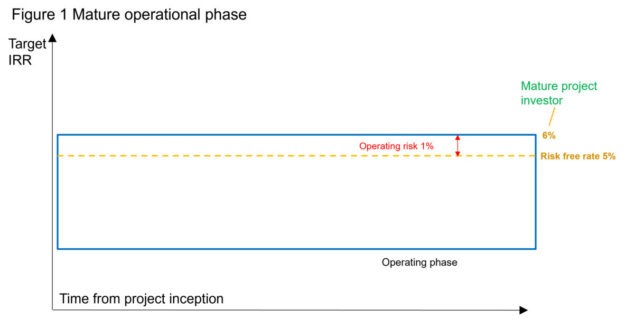
Figure 1 shows returns coming in two parts: the risk-free rate and a risk-premium for operational risk. Any investor wants to get at least the risk-free rate, which is the return on a safe government bond, indicated here at 5%. The full operating life of a new toll road contract might be 30 years or more, so the nearest comparison is to a long term government bond.
All assets are in some way more risky than a government bond, but a mature toll road, at least in a low risk country, is not much riskier. For a fully proven and operational toll road, the main risk is operational, meaning that something might go wrong with the maintenance or there may be an accident that damages the highway. These risks are not zero but they are small and can be minimised by effective management of the road. The owner of a mature toll road therefore might expect only a small additional return over long term government bonds, which we indicate as 1%.
So an investor seeking a stable and low risk long term asset might be satisfied with an IRR of just 6% in this case.
ii) Traffic risk
But projects don’t immediate become mature and proven. They emerge through a series of stages where risks have to be dealt with and compensated for. The stage before a toll road becomes mature and proven is when it is first opened and the level of traffic is revealed. This is a crucial number for generating the level of revenue. Although the toll may be flexible within limits (depending on the contract signed with the government) it cannot compensate for a large shortfall in traffic. Until the opening and early months of usage of the toll road, the volume of traffic is just a forecast. And forecasts are sometimes wrong.
An investor who buys into the toll road before the traffic volume has become clear is therefore taking considerably more risk than the later investor, who owns a fully proven asset. That traffic risk needs to be compensated. History shows that traffic forecasts are sometimes quite wrong, and usually in an optimistic direction. So we assume a 3% additional risk premium for an investor bearing this risk (figure 2).
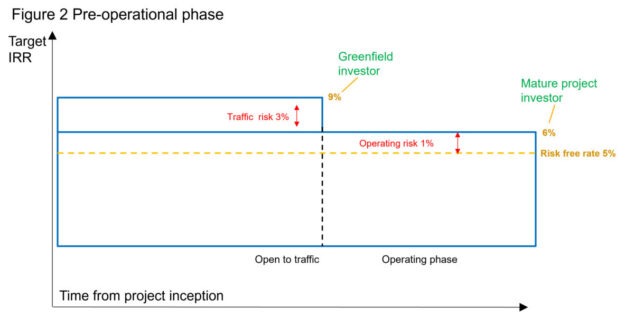
If the traffic demand comes in on or above forecast, then the traffic risk largely disappears (other than in the case of major changes in the economy or competing transport projects). Indeed traffic usually increases over time, with rising car ownership and prosperity. So the investor buying in at the point the project is complete but not yet open, who then finds the traffic risk disappearing, would make a capital gain. That investor could either hold the investment for the long term, or realise a capital gain by selling at a profit to the mature stage investor.
The traffic risk is broadly equivalent to the commercial risk in other investments, where the market demand for a product is not yet proven. The problem for a toll road, or many other types of transport assets, is that once the road (or bridge, tunnel, airport etc) has been built, there is not much that can be done to affect demand, at least in the short term. If it turns out the forecast demand is over-optimistic, there is likely to be a long term shortfall in the revenue generated. But the capital costs are fixed by this stage and operating costs are not usually very flexible. For some commercial products, changing the design, re-branding and advertising may boost demand, this is less likely to work in the case of transport projects, again for at least some years.
iii) Construction risk
Building any new asset always brings construction risk, which also has to be compensated through a higher return (figure 3). For a standard sort of asset such as a road over flat or otherwise unproblematic terrain, this risk may be relatively low. But if it involves novel construction techniques, tunnels, bridges or the crossing of unusual territory (marsh, swamp, permafrost, desert), the risks may be much higher. If the project has to be suspended owing to protests or legal challenges, the risk also rises, since the capital cost of construction is directly proportional to how long it takes.
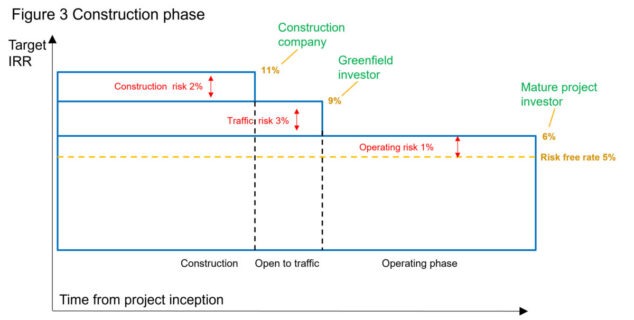
In this case we assume the construction risk is relatively low, requiring an additional 2% of return. So an investor who buys into the project when it is all approved and just about to start construction, would require a total expected IRR of 11%. If the project goes to plan and is built on time and budget, that construction risk drops out. An investor who took that risk would have invested at a prospective return of 11% but now own an asset that might be sold on to another investor who would only need 9% to bear the additional risks, allowing a capital gain to be realised.
iv) Development risk
The very first stage of the project is the development phase (figure 4). This is where a pure idea turns into a project has all the necessary planning approvals, environmental assessments and political consent. In developed countries such as the UK or US this can be a long, costly and risky process. A team of people might spend years on a project idea, only to find that it fails for some reason. This risk, which we can loosely term the political risk, also needs to be compensated.
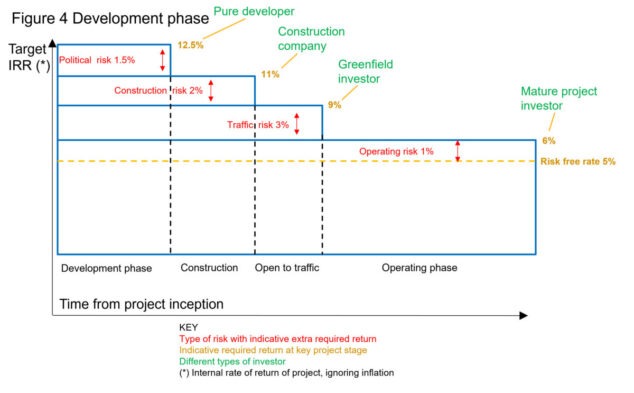
In figure 4 we show an indicative additional return of 1.5% but this might vary considerably depending on the type of project and the country where its to be built. The more standard, uncontroversial and predictable the project, the lower the risk. But it is not always obvious in advance where the problems will lie. Specialist project developers seeking higher returns may work on this phase, which requires less capital than the construction phase, getting a project ready for financing and building, and then selling it to developers who are happy to then proceed to construction.
Although we’ve shown each stage as if attracting different types of investors, there are companies happy to do all stages from development through to mature operation, who then might sell the de-risked project (other than operational risk, which cannot be avoided) to long term institutional investors such as pension funds or sovereign wealth funds. Using our indicative IRR figures, that would mean going from an expected return of 12.5% to a project that only needs to pay 6%. That is equivalent to a capital gain of nearly 100%, ignoring the time value of money, taxes and transaction costs.
Managing traffic demand risk: availability payments
The risk that is distinctive in new toll roads, and in many other transport projects (roads, tunnels, airports) is that user demand is less than forecast. This has led to several financial failures in the last few decades, of which one of the most famous is the Channel Tunnel project, which opened in 1994 to much lower traffic than expected.
Several toll road projects also got into trouble, including the M7 Clem Jones Tunnel (CLEM7) project in Brisbane, Australia, which opened in 2010, but saw an early fall in traffic (alongside complaints at the cost of the toll). The owner RiverCity Motorways went into receivership in 2011, having been unable to service its debt.
A 40 mile segment of Texas State Highway 130 in the USA was opened in 2012 as a by-pass around the city of Austin, to increase road capacity for trucks, following the economic boost to US-Mexico traffic from the North American Free Trade Agreement. The private consortium that financed ($1.3bn), built and operated the road under a 50 year concession, went into Chapter 11 bankruptcy in 2016 because toll revenue was too low.
The M6 Toll Road near Birmingham, the UK’s only private toll road, which opened in 2003, has suffered from traffic volumes only around half what was forecast. The original investors were Australian Macquarie Infrastructure Group (75%) and Italian toll road company Autostrade (25%), both experienced in this type of investment, but they ended up losing most of their money. The road passed to the banks who provided the debt finance, who sold it on to another investment consortium (also Australian).
Following these and other cases, more recent toll roads have shifted to an availability payment model: the owner and operator receives a fee for keeping the road open and well maintained, but the traffic risk is in effect put back to the state or government. This has reduced the risk to investors, who were in danger of giving up on toll roads as an investment class. Alternatively the government can provide a minimum revenue guarantee to insure against traffic shortfall.
The World Bank in 2022 published a detailed manual on all aspects of managing toll road traffic demand forecasts and risk, which reports evidence of systematic over-optimistic forecasting of traffic demand. That report contains a typology that captures the full range of toll road options (figure 5).
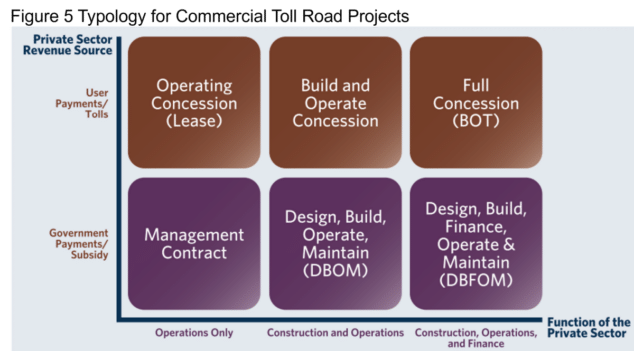
The most common form of private toll road contract is the Design, Build, Finance, Operate and Maintain (DBFOM) which puts all construction, financing and operational responsibility into the private sector, but leaves at least some of the traffic risk with the government. This has largely replaced the earlier full concession model, where the private owners had the full traffic risk.
What kind of investors?
Table 1 shows some examples of the kind of investors in toll roads, at different stages of the project.
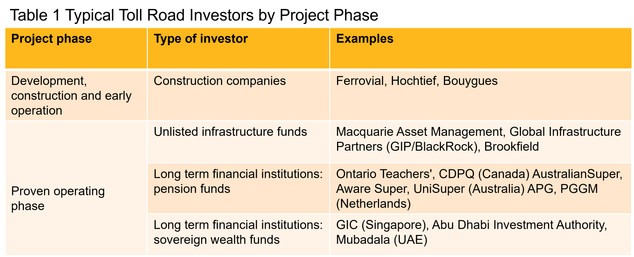
The Canadian and Australian pension funds are far greater investors in infrastructure project generally, not just toll roads, than most other OECD pension funds.
Conclusion: a very useful approach
Toll roads are a proven and effective way of paying for road construction and use. The toll income can be used to pay for private investment, though the traffic risk has to be managed. We haven’t referred here to the use of tolls for public or government owners, but this is common too, especially in the USA.
A toll is efficient – it makes users confront the cost of their decision – and fair – the users pay for the service, rather than charging it to the wider population. It’s not surprising that around 80 countries use some form of toll road.
Leave a Reply