

Bubbles are an enduring feature of financial and commodity markets. But it is when they are driven by debt that their bursting becomes dangerous
*
The best book I’ve read on financial bubbles is William Quinn and John D. Turner’s “Boom and Bust: A Global History of Financial Bubbles“. It covers the famous ones like the Mississippi Bubble (France) and South Sea Bubble (Great Britain), both in the period 1719-20, the “railway mania” of 1844-46 (Britain, and the US), the “Roaring Twenties” of 1920-31 (US) and of course the Dot-com Bubble of the last decade of the twentieth century (US, Germany and other countries). It also includes the lesser known bubble in company and mining stocks in Britain in 1824-26, the Australian Land Boom of the 1880s, and the Bicycle Mania (yes, really) in Britain in 1895-98.
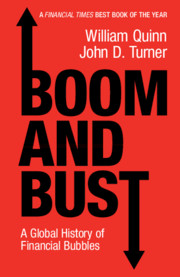
Source: Cambridge University Press
This by no means exhaustive list shows that bubbles happen repeatedly, in varying types of assets (company shares, land, infrastructure) and in varying places, and that the same countries fail to learn any lessons. China, having newly joined the capitalist global economy in the 1980s, has since had its own stockmarket bubble in 2015, and more recently a real estate bubble, the bursting of which is still in progress. Time will tell whether China manages to rival the great land bubble in Japan, which, together with the bubbles in company shares, has a good claim to being the greatest ever bubble in human history – so far.
But not all bubbles are followed by wider financial crises. Although the South Sea Bubble in Britain is famous, Quinn and Turner argue that it wasn’t actually that damaging, and its fame arises from its novelty and the fact that many members of the rich and famous got caught up in it and wrote about it. Sir Isaac Newton, reportedly embittered for the rest of his life having lost a great deal of the money he made from running the Royal Mint, is only one of those affected.
The Dot-Com, or as I prefer to call it Technology Media and Telecoms (TMT) bubble of the late 1990s is also famous but was followed by a fairly mild recession in 2001. I recall in late September and early October 2001, in the wake of the 9/11 attacks, the macroeconomics team at JPMorgan agonising over whether to change their forecast to the US entering recession, because they hated to appear to be kicking the US when it was already down (and you thought these people had no souls, right?). They were rescued by the National Bureau of Economic Recession, the official body for declaring whether the US is in recession, announcing that the US economy was already in recession, and had been since the Spring of 2001.
Debt is the danger
The point is that some bubbles are pure speculative excess, albeit sometimes based on a real technological change (railways, the internet), in which values rise then fall; others are fuelled by debt and these are the dangerous ones. The mechanism is forced selling. If a person becomes wealthy on paper because they own shares, commodities, land or tulip bulbs (Netherlands, 1634-37) but they haven’t borrowed to buy these things, then a fall in value that leaves them less wealthy than before. While no doubt very disappointing, this loss of value doesn’t necessarily change their behaviour much. Economists refer to wealth effects, the change in spending owing to a perceived change in a person’s wealth. Most people do spend a little more on the back of wealth effects, and correspondingly cut back a bit if the wealth increase goes into reverse. But the changes are relatively small, in line with economic theory that suggests people do take something of a longer term view.
But if they have borrowed to buy land, shares or other assets, and those asset fall in value, they may find that their wealth is actually negative – they owe more than the value of the assets. This unpleasant situation is the more acute if they debt is short term and the lender demands immediate repayment, just when the miserable speculator has nothing left to sell.
Andrew Ross Sorkin’s recent entertaining and thoroughly researched book “1929: The Inside Story of the Greatest Crash in Wall Street History” tells us why that crash seared itself onto a generation of American minds (*). Not only were many, relatively ordinary people invested in the stock market, but they mostly did it on debt – what was (and still is) called margin. A stockbroker or bank may be happy to lend you money to speculate; when the share values go up, this looks like good business for them and genius for you, as leverage (debt) always does on the way up. It’s called leverage because debt, which involves a fixed obligation to pay back the money, magnifies gains made by investing/gambling that money on an asset which rises in price. Unfortunately, leverage (except when done through derivatives) works in both directions – losses are magnified too.
Lest everyone congratulate themselves on avoiding the temptations of leverage, I have to point out that most people in wealthy countries take on leverage in the form of mortgage debt, to buy their homes. This is not necessarily a bad thing: banks that lend to retail customers are (these days) quite careful who they lend to, they demand a large amount of equity from the borrower (the deposit) and the loans are usually for 25 or 30 years. Even so, real estate values don’t always go up, as American home owners found out in 2007.
In Britain, a generation of borrowers were hurt by the roughly one third real terms fall in property prices in Britain in the early 1990s, when the term “negative equity” entered the public consciousness. After the deepest recession since the 1930s in the early 1980s, caused by the Thatcher government’s macroeconomic policy errors, there followed a consumer boom, driven by deregulation of credit and the country spending North Sea oil revenues on cars, televisions and unemployment benefit. This drove a property boom, the ending of which was triggered by the withdrawal of tax breaks on mortgage interest in 1989. House values fell for the next four years. A new housing development in the west of England became emblematic of the bust, as most of the new owners bought at the top of the market. Officially named Bradley Stoke, the media renamed it Sadly Broke (**).
Real estate bubbles are usually fuelled by debt because property makes good collateral, in the eyes of lenders. The problem comes when there is a general rise in property values (either retail or commercial, or both), making the value of collateral rise and thereby encouraging banks to lend even more. At some point values reach a peak, sometimes not clearly until after the event, and the banks and other lenders all stop lending in unison, contributing to a widespread and abrupt withdrawal of credit across the economy.
In the US this sudden fall in lending, even to creditworthy borrowers, is aptly called a “credit crunch”. The credit crunch, combined with a general cut in spending by borrowers who now realise they aren’t as wealthy as they thought, made worse by those who are forced to sell into an already falling market, adds up to general fall in demand and typically causes a recession. Central banks then cut interest rates, become more lenient to distressed banks, and gradually nurse the economy back to health. Everyone agrees this must never happen again, reports are written, lessons must be learned and so on and so forth. And after a few years, perhaps the time it takes for a new generation of borrowers and lenders to emerge with no memory of the bubble, we repeat the whole merry story once more.
Naturally the questions today are: a) whether the current enthusiasm for AI-related investing is a bubble; and b) if it is, is it fuelled by debt? It is too soon to give a definitive answer to either of these. Early in the enormous capital spending boom that got going in 2025, many took comfort in the fact that the companies doing the investing were generally free of debt and able to finance the spending out of their existing free (i.e. surplus) cashflow. But the growing size of the capital spending ambitions is forcing some of these companies to start borrowing for the first time in their lives, and to harness debt from other lenders through off-balance sheet structures that look disturbingly familiar to those who lived through the financial crisis of 2007-08, itself based on a real estate boom.
If the trend of rising debt continues, the risk that the bursting of the AI bubble (if that is indeed what we are witnessing) causes wider harm to economy will be sharply increased. You have been warned.
***
(*) The 23% fall in the Dow Jones Industrial Average (DJIA) index on October 19, 1987 was the largest single day fall in the US market in history. It was called Black Monday, the name itself a nod to the history of 1929. What made the Wall Street crash of 1929 so bad was a sequence of falls, including Black Thursday, Black Monday and Black Tuesday, then an extended period of less dramatic falls (interspersed with occasional rallies) that took the cumulative fall in the DJIA by July 1932 to 89%. The DJIA only regained its former peak (in nominal, not inflation-adjusted terms) in 1954. By contrast, the day after 1987’s Black Monday was a great time to buy the US market, which took off in a more or less continuous rise until the peak of the Dot-Com boom in 2001.
(**) As an economist and then finance professor, I’ve had friends, family and sometimes even complete strangers often ask me for financial advice. Other than when I was in the City and actually paid (and regulated) to give advice, I have strenuously tried to avoid giving any. (If absolutely pushed, I might say something to the effect that in general, probably, most finance professors would tend to say that a typical investor with a long time horizon would probably be well advised to put some of their wealth in a low cost global equity tracker fund, followed by various disclaimers.) I only once failed to follow my own rule, when in 1989 I all but begged my then girlfriend to delay buying an apartment, as it seemed as clear as these things ever can be, that the market was about to fall. I don’t know if she would have been as annoyed with me if I had been wrong, but she was certainly annoyed when I was right. Her apartment value eventually recovered; the relationship did not.
Further reading
The March 2026 IMF F&D (Finance & Development) magazine, which I highly recommend (it’s free to subscribe), has an issue themed around debt. Two particularly interesting articles are Alan Auerbach on the US federal debt problem and Barry Eichengreen et al on the remarkable and positive story of Jamaica’s successful debt reduction programme.
Leave a Reply